I’d wanted to visit Trieste for over 20 years, since reading Trieste and the Meaning of Nowhere by Jan Morris. During those two decades, other cities got me first, more obvious places, like Venice. But Trieste had lodged itself in my psyche, its name alone igniting longing: triste means sad in Italian. And the addition of the extra ‘e’ seemed to perfectly evoke the city Morris described as being ‘almost like an ecstasy of the poignant.’
I pictured it like a de Chirco painting, with vast piazzas, majestic yet empty, its past grandeur, as the Austro-Hungarian empire’s main seaport, now faded.
But when we arrived, from the nearby Slovenian border, it seemed like so many other bustling European cities, with its wide boulevards, flanked by nineteenth century apartment buildings with pasticcerias and farmacias at street level, and its narrower, winding backstreets. Where was the otherness Morris had so beautifully described?
I first encountered it the next day, at Miramar, a castle built from white Istrian stone, on a promontory at the city’s western edge. It was the love-project of Maximilian, the Hapsburg Duke, who created it for his young bride, Carlotta. A home they inhabited only briefly, before being posted to Mexico, where Maximilian was later shot dead. Standing in its luxurious and still pristine rooms, overlooking the blue Adriatic, I sensed the ache of abandoned dreams, of life’s unpredictability.

I found it again as I meandered through the city: in the quiet of its vast main square, Piazza Unita D’Italia, with its imposing civic buildings and mere scattering of people, its fourth side giving way to an expanse of sea. And in the cool, dark interior of one of the world’s most beautiful cafés, Antico Caffè San Marco, its glass cabinet filled with Sachertorte, Apple Strudel and the latticed crust of Linzertorte an ode to Mitteleuropa. And where, on a Thursday lunchtime, a mournful-lookingman in sunglasses drank white wine at one of the few occupied tables.

And, finally, I found it standing in a chapel, perched on a hill above the city. We’d been intrigued by its concrete form, visible from the promenade, and shaped like a truncated pyramid. We hadn’t expected a 45-metre high space, some fifty thousand feet in volume. Nor to be the only ones there on this June afternoon.
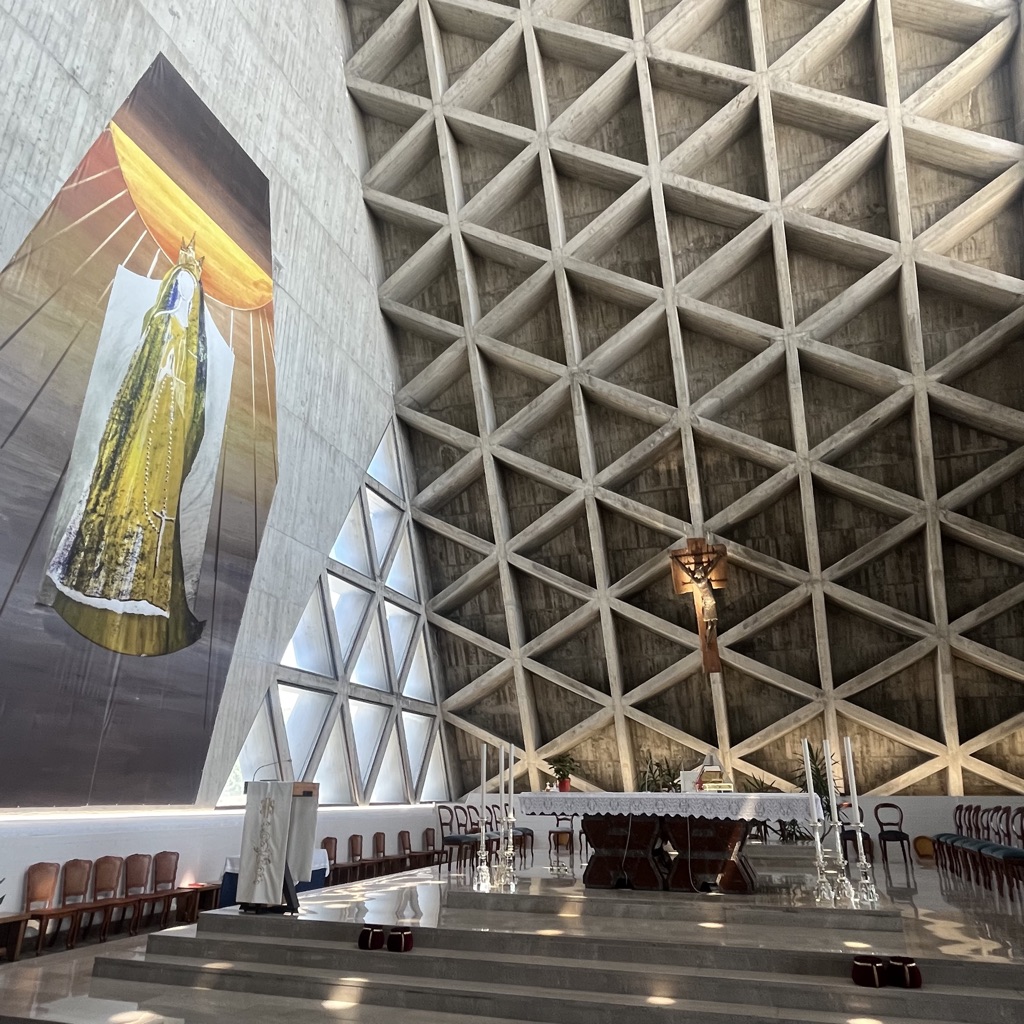
Would I have experienced its otherness had I not read Morris’s book? Possibly. But the beauty of words and stories is they hold the potential to resculpt our vision, guiding us towards what we might otherwise have overlooked.
Annabel Chown, June 2024
 Blue Door Press