On the Pleasure of Literary Picnics

I’ve changed my life because of a picnic I once read about in a book so it’s fair to say that I take literary picnics seriously.

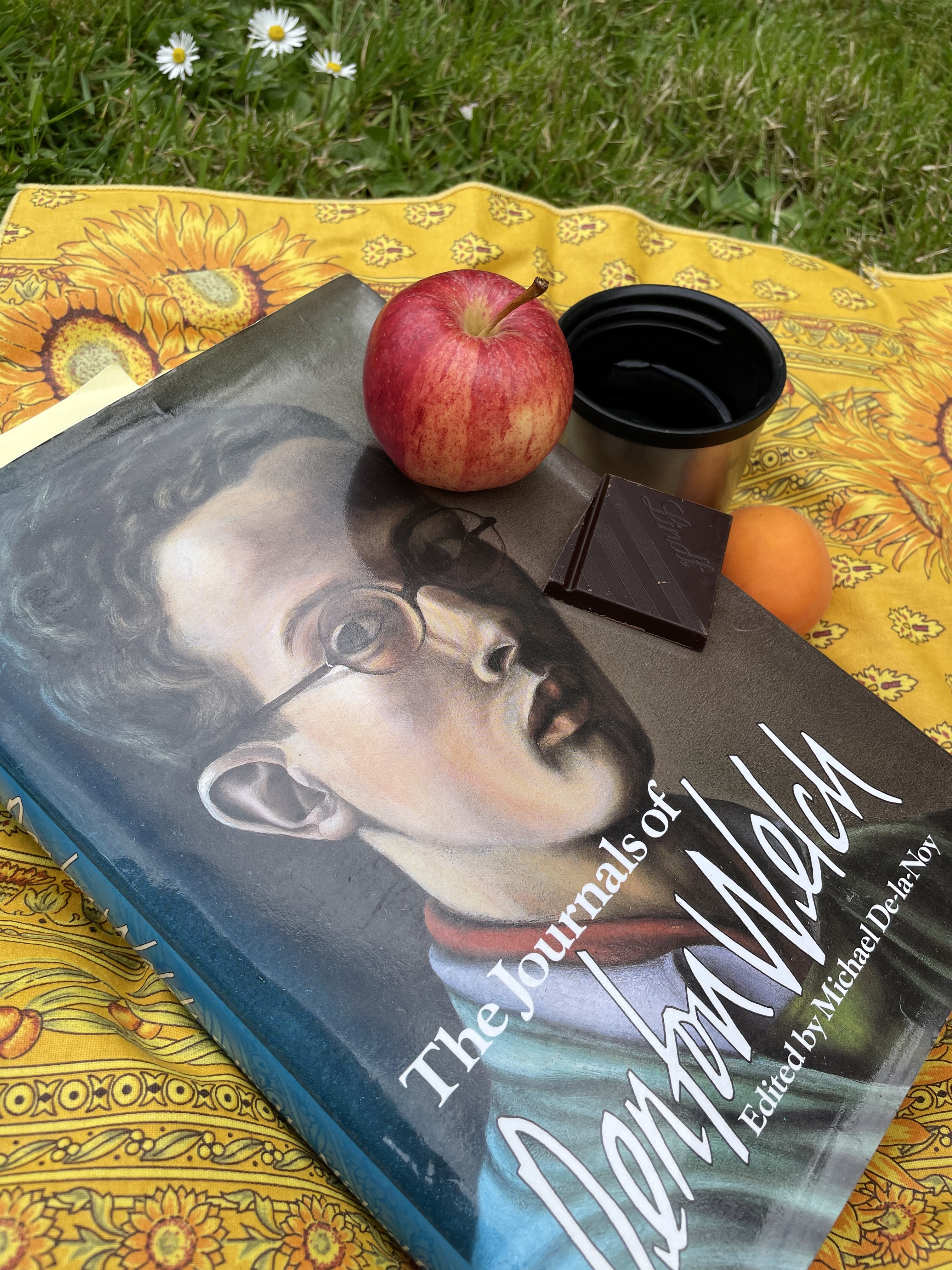
I first fell in love with the 1930s writer, Denton Welch, because of his exact accounts of picnics taken in the countryside around Kent. In our twenties and living in London, my husband and I would copy Denton’s picnics and cycle round the countryside, trying to stop in exactly the same spots Denton had.

So, several decades later, when we wanted to move back South from Edinburgh, we remembered those country lanes and moved to live in Kent, largely because of how we’d grown to love it through Denton’s picnics.

Here’s his diary entry for 26th October 1944: There were cows in the field opposite, in the misty atmosphere, and beyond on the opposite hill Tudorized houses lost in the soft mist. We ate cheese, fruit cake, biscuits, toast, drank coffee and I ate the only orange in pigs.

            Then we smoked the Dunhill cigarettes that I had bought, and an old lady came behind us and said over the fence, ‘Excuse me, but would you like any boiling water? Can I get you any boiling water?’ I told her we had just drunk our thermos of coffee and she went away immediately to her house saying, “I see, quite, quite.’

Perhaps because he insisted on having picnics through the year, his best were ones that involved a thermos and four squares of dark chocolate. Four squares exactly, not a bar, or even ‘some chocolate’.
Be exact, writers, because your readers will be eating along with you.

Or nearly always. I tried to find the earliest account of a literary picnic and came up with Anthony Trollope in Can You Forgive Her (1864):

‘There are servants to wait, there is champagne, there is dancing, and instead of a ruined priory, an old upturned boat to be converted into a dining room.’

Hmmm.

But if the Trollope account is a little too aspirational for most of us, then what exactly is a picnic? Maybe it’s a breakfast of bananas and sweet corn cooked on a static barbecue in a full car park? Our annual summer holiday treat has now gone into family myth, not least because of the sight of our normally office-bound father struggling to feel at home in the great outdoors. And what could be more British than seeing picnickers sitting right next to their cars as they watch the traffic go by?

At least Patricia Highsmith took her characters off the motorway in The Price of Salt (which became the film, Carol):

Then they drove into a little road off the highway and stopped, and opened the box of sandwiches Richard’s mother had put up. There was also a dill pickle, a mozzarella cheese, and a couple of hard boiled eggs. Therese had forgotten to ask for an opener, so she couldn’t open the beer, but there was coffee in the thermos. She put the beer can on the floor in the back of the car.

            ‘Caviar. How very, very nice of them,’ Carol said, looking inside a sandwich. ‘Do you like caviar?’

At the other extreme, there was the time I went to play with a new school friend, and her mother threw jam sandwiches out of the window at us so we wouldn’t disturb her at lunchtime. That didn’t feel like much of a picnic so, while there should be an illusion of ‘roughing it’, perhaps there also needs some care involved.

 ‘You English,’ my Dutch neighbour says about the way her British husband fusses with filling the thermos, preparing fruit and yes, why not, a rug to sit on. ‘Why can’t you take some bread with you and be done with it?’

Perhaps our classic children’s literature is to blame. The lashings of ginger pop enjoyed by the Famous Five, or Ratty’s famous cold-tongue-cold-ham-cold-beef-pickled-onions-salad-french-bread-cress-and-widge-spotted-meat-ginger-beer-lemonade — ” from the Wind in the Willows.

If Ratty had just said he’d got a picnic, even a large one, then who would have been interested? Not me. And I certainly wouldn’t have begged Mum to take pickled onions with us next time we went on a picnic.

I know I’m not alone in loving detailed food descriptions laid out on the page. Recently I had a brain freeze and couldn’t remember the name of a favourite children’s book, so I asked on social media, ‘What’s the name of the book where they have those little sugar biscuits with iced flowers?’

The Little White Horse, several people answered in minutes. And there then followed an animated discussion of all the food Marmaduke Scarlet cooked for Maria Merryweather. So perhaps it’s not surprising that Harry Potter eats well at times too, given that J K Rowling has admitted how Elizabeth Goudge has influenced her.

Among the classics, Jane Austen is the mistress of the niceties and challenges of a picnic – perhaps because she gets so well how it could all go horribly wrong. Her deliciously snobbish Mrs Elton in Emma, has all the important details planned in advance, as she explains to Mr Knightley. ‘I shall wear a large bonnet and bring one of my little baskets hanging on my arm…. Nothing can be more simple you see… There is to be no form or parade – a sort of gipsy party. We are to walk about your gardens, and gather the strawberries ourselves, and sit under trees; and whatever else you may like to provide, it is to be all out of doors, a table spread in the shade, you know. Everything as natural and simple as possible.’

But Mr Knightley is a man I could never fall in love with. He insisted on having the meal inside with servants and furniture, large bonnets optional.

Perhaps he was feeling under siege like the poor oysters flattered into joining the walrus and the carpenter on their sea-side picnic until:

‘A loaf of bread,’ the Walrus said,

‘Is what we chiefly need:

Pepper and vinegar besides

are very good indeed –

Now if you’re ready, Oysters dear,

We can begin to feed.

I used to love this poem until I’d realised exactly what was going on. Perhaps the best literary picnics – like many in real life – are those that teeter on the verge of disaster, such as the glorious beach picnic in Gerald Durrell’s short story ‘The Picnic’, where the family settled on what they thought was a rock but turned out to be the side of a dead horse.

I wonder too if the weather is another reason why the British love eating outside? Because we can never really plan ahead for a sunny day, we don’t let a ‘spot of weather’ put us off. As Edwin Morgan writes:

In a little rainy mist of white and grey

we sat under an old tree,

drank tea toasts to the powdery mountain,

undrunk got merry, played catch

with the empty flask…

In her wartime diaries, Love is Blue, Joan Wyndham writes about one definitely un-Blyton picnic: We lay under a tree in the wind and the rain eating peaches while Zoltan kissed my thighs with his usual air of grave, sad absorption. He undid his shirt so I could put my hand over his heart, and the wind roared in the trees and whipped back my hair.’

Can’t you just taste those peaches?

Oh, your attention went elsewhere? Back to the food, people.

Although not perhaps PG Wodehouse’s picnic in Very Good Jeeves:

I met a fellow the other day who told me he unpacked his basket and found the champagne had burst and together with the salad dressing had soaked into the ham, which in turn had got mixed up with the gorgonzola cheese forming a kind of pasta … Oh, he ate the mixture but he said he could taste it even now.

Well, if the food isn’t that good, at least a picnic can offer the chance to explore. Not just a geographical place, but to escape the routine of day-to-day. A packed lunch made at home to take to the office every day is NOT a picnic. However, the same food brought by someone coming to surprise you with a lunch to take outside in the park is definitely a picnic in my book.

So a picnic can help us try something new. Escaping the routine of day-to-day. Which is, after all, very much what reading for pleasure can be.

‘O stop, stop,’ cried the Mole in ecstasies: ‘This is too much.’

            ‘Do you really think so?’ inquired the Rat seriously. ‘It’s only what I always take on these little excursions, and the other animals are always telling me that I’m a mean beast and cut it very fine!’

            The Mole never heard a word he was saying. Absorbed in the new life he was entering upon, intoxicated with the sparkle, the ripple, the scents and the sounds and the sunlight, he trailed a paw in the water and dreamed long waking dreams.’

Sarah Salway, May 2023

What’s The Story?

It’s intriguing to find a book gathering its own stories besides the one contained between its covers

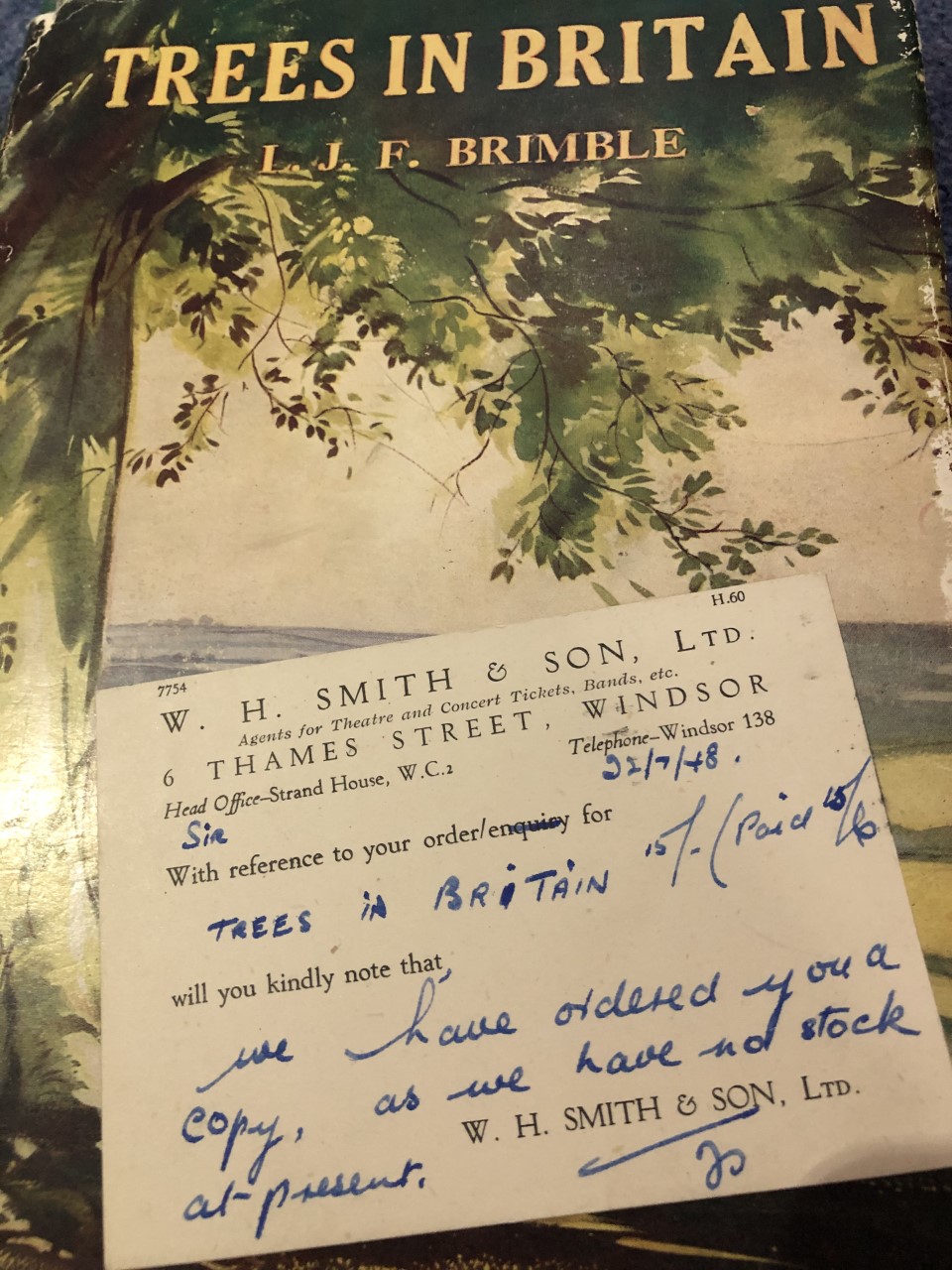
In 1948 D H Hardwick ordered a copy of Trees In Britain by L. F. J Brimble from WH Smith. It was to be sent to him in the Military Wing of Harefield County Hospital in Uxbridge.

In 2020, author Sarah Salway, recently discharged from hospital herself, came across that same copy of the book in a charity shop.  Having been seriously ill with silent hypoxia in the first wave of Covid 19, Sarah was learning to breathe again. She’d become fascinated by trees, the breathing they do for us, and used the book to learn to identify trees in her local park on her daily walks.

However, a further fascination came when a postcard fell out of the book revealing the details of Hardwick’s original order to W H Smith 72 years previously.

Feeling an affinity with the hospitalised Hardwick, Sarah began to research him and discovered he had a distinguished career as a pilot in the RAF in WW2. As she was emerging from her ‘battle’ with Covid 19, She was pleased to discover this man was a survivor of many missions.

Sarah wrote about this experience in ‘Learning To Breathe with Trees,’ the first essay Blue Door Press published in the anthology, Altogether Elsewhere.

Unbeknown to Sarah, the story of the book was about to have a new chapter.  It turns out that D H Hardwick was hero to another – his nephew Mike Hardwick. Mike was researching his uncle’s wartime career. His internet trawling led him to read Sarah’s essay on Blue Door Press. He contacted her via her website. They corresponded by email and spoke on the telephone.

Sarah learned much more about her tree book hero: the battles he’d survived, what an inspiring uncle he had been to the young Mike, the post-war life he’d led until his death in 1990.  In turn, Sarah returned the book and the postcard to Mike Hardwick, who is thrilled to discover that his hero, uncle Den, had such a positive effect on Sarah’s recovery. 

It goes to show the importance of putting your story out there, as Annabel Chown wrote in her recent piece. You never know – your story might find its way into someone else’s. I wonder if there are any descendants of L. J. F. Brimble – botanist and form editor of the journal, Nature – who might be pleased to discover the stories Trees In Britain has found its way into.

Pamela Johnson, August 2022

Learning to Breathe With Trees Sarah Salway

a place close to home becomes important as Sarah begins to recover from Covid-19

‘You have to breathe properly,’ Richy, the Filipino nurse, tells me on my first night in the COVID isolation ward, his visor misting up with his own breath. ‘You are too shallow. If you leave here, you need to put yourself out in the world more. Breathe. Breathe.’ 

Macintosh HD:Users:pam:Desktop:sarah images for Anthology :hospital bed.jpg
Covid isolation ward: patient’s eye view

While I’m deep breathing – slowly in through the nose, puffing out through the mouth, putting myself out there – I remember reading that every window in this hospital is supposed to look out at a tree. Somehow I manage to shuffle to the window but all I can see is a concrete courtyard and two people smoking by some bins. Determined to see some nature, I stand on tiptoes, squashing my head sideways against the glass. Ah, there it is, the top of something that looks like a … 

‘What are you are doing?’ Richy has come into my room without me hearing him. A feat indeed in full PPE. ‘You’ll exhaust yourself. Get back to bed.’ I remember his ‘if’ and not ‘when’ about going home, and go back to practising my breathing.

Macintosh HD:Users:pam:Desktop:sarah images for Anthology :hospital window.jpg
‘All I can see is a concrete courtyard’

*

The Grove, a small park behind my house was given to Tunbridge Wells by the Duke of Buckingham in the seventeenth century. It was planted thickly and mostly with oaks as somewhere for visitors to promenade when they were tired of gambling. 

After the 1987 hurricane destroyed many of the park’s trees, other varieties were planted. Before Covid, I had a plan to identify them all, and had bought an old hardback book, Trees in Britain by L J F Brimble from our local charity bookshop. 

It was only when I’d got home that a postcard fell out –  the original handwritten order from W H Smith & Son of Thames Street, Windsor, dated 22nd July 1948. I was intrigued to see it was addressed to D H Hardwick of the Military Wing of Harefield County Hospital in Uxbridge. That’s interesting, I thought, putting it aside to investigate when I had more time.

‘It was only when I’d got home that a postcard fell out – the original handwritten order from W H Smith & Son’

*

One of the common symptoms of the Corona Virus is a difficulty in breathing, but doctors are finding some patients have Silent Hypoxia, the medical term for when someone has dangerously low oxygen levels but is still able to function. This is the case with me. 

I’m hesitant about ringing 111 at first but once the paramedics arrive and test me, it takes just minutes before I’m in an ambulance. From my seat in the back, I hear fragments from urgent sounding telephone calls, ‘Red route,’ ‘Need to be quick’, and I wonder which poor person they are talking about. Then I realise it’s me. An hour later I’m in a hospital bed on oxygen, remaining there for six days. 

When I eventually come out, it is to a different world. The country’s in lockdown because to touch someone could be to kill them and we are only allowed out one hour a day. I’m still frail anyway, so it is enough for me to totter round The Grove barely noticing the trees. But doing the same route daily means I’m aware of how much stronger I am getting as the weeks creep by. Like many others, I also start to hunger more for nature.

‘Was this tree always this colour?’ a man asks me during one walk. He’s standing by a copper birch, its rich purple leaves showcased by the smooth grey bark. I tell him I can’t remember, but has he seen the Christmas tree blossoms on the horse chestnut? We agree that all the trees are particularly amazing this year. 

It seems the perfect time to go back to my plan of learning the trees in the park by name. I get out my old book, and the postcard falls out again. 

*

It’s easy to find out about Harefield Hospital, the address my book was originally sent to. It’s now one of the ‘lost hospitals of London’ but was once the home of an Australian family, the Billyard-Leakes. They’d offered it to the Australian government in wartime for the treatment of injured Australian and New Zealand soldiers, and by 1940 it had gained an international reputation for treating disease and injury to the lungs and oesophagus.

D H Hardwick, the man, takes longer to track down. Eventually I find out he was an officer of the Royal Air Force Voluntary Reserve, winning the Distinguished Flying Cross during the Battle of Arnhem. This was a brutal battle and out of nearly 9,000 men taking part from the 1st Airborne Regiment (which my D H Hardwick as Flight Officer belonged to) only 2,000 came home. So the man who first owned my tree book had officially been a survivor. 

*

And now I am one too. Apparently I have ‘battled’ through, I’m a ‘warrior’, and I’ve won the ultimate medal for 2020: ‘Covid Survivor’. But when I talk to others who have shared my experience of being admitted to hospital, we agree that we were never in a state to fight anything, and if there’s a metaphor that works better for us than war language, it’s the idea of a computer virus. Our bodies have been contaminated with unsafe messages rushing through our veins. So much of what we thought we knew – such as how to breathe – has to be wiped clean before we can function again. 

*

Stalking D H Hardwick online proves to be the perfect gentle distraction as I recover. From military websites, I’ve found out his first names were Dennis Henden and he was born in Auckland in 1917. In fact, he was one of many New Zealanders who joined the Royal Air Force, and his squadron was involved with the SOE, or Special Operations Executive. He was also described as a ‘surveyor’, which probably involved him staking out enemy territory. What I still find most interesting about him though was how, while he was recovering in a hospital so far from home and several years after the war had ended, he had ordered a book so he could learn more about English trees. 

It seems an almost heroic curiosity, and makes me ashamed of how I’ve always been too busy to bother learning my own landscape properly. There are so many things we take for granted until we nearly lose them. Every day now, my phone fills with photographs of flowers and skies from friends, and I study every one closely as if the natural world is a book I need to translate. Images of trees fill me with special delight.

*

My daily breathing exercises seem to be helping. Although it looks as if one of my lungs may have some permanent damage, my oxygen levels are nearly back to normal. However on a Whatsapp group imaginatively called, ‘Covid Survivors’, we talk openly about PTSD and panic attacks. It’s the sort of thing none of us can discuss easily with friends and family, because we’re aware of how much they want us to be back to ‘normal’. 

I think of my father who never talked about his war experiences, and I can understand better why this was now. His bad memories were a living reminder that trauma not only sticks around, but may even be contagious. We are luckier nowadays, and in my Whatsapp group, we share the names of our therapists, talking about how they help by letting us go over everything to someone who isn’t emotionally involved. We don’t want to upset our families, or as one member calls everyone who hasn’t had the virus, ‘the civilians’.

*

Dennis Hardwick flew a Stirling IV. I know this because, during one of my internet searches, I find a photograph he is credited with taking of this plane. It looks like a bulky insect, and I imagine it buzzing through the trees, dropping spies into enemy territory like eggs. I read his citation for when he received the Distinguished Flying Cross. In 1944, he was flying to drop supplies to British ground forces in Holland when his aircraft was hit, killing one member of the crew and wounding another. The aircraft went out of control, diving steeply, but Dennis succeeded in levelling out. The citation says, ‘Although the damaged aircraft was difficult to control this resolute pilot flew it to base and made a safe landing. Flying Officer Hardwick displayed commendable skill and coolness in hazardous circumstances.’ Even though it’s ridiculous to be proud of someone with whom you have no connection, I can’t help stroking my/his book. Well done, I whisper to it.  

*

A few years ago I went to a workshop on Natural Navigation for a magazine article I was writing about getting lost. We were a diverse group, brought together only by a desire to learn how to find our way using clues from nature. In our introductions, one man announced he was a pilot. He could navigate anywhere in the sky, he said, but on land he was always getting lost. 

I think of Dennis Hardwick as rather like that pilot. Still in a Military Hospital in 1948, unlikely to fly again, he must have been navigating a way through his new landscape tree by tree by tree. 

Did he know then that the average tree produces enough oxygen in one year to keep a family of four breathing? Both Dennis and I found ourselves desperately in need of oxygen, but I think trees gave us more than simply being the world’s lungs when our own weren’t working. Through them, we learnt a different language, a better way of understanding the world that we had been given this second precious chance to walk in. Perhaps us both owning this book at our different times of need is a sign of how we refused to take that for granted. Learning to call the trees by their real names was the least we can do. I imagine both of us wheezing gently through the same pages of the book, taking it out to the same type of parks, staring at the same leaves. 

*

I still don’t know what happened to Dennis after he left the hospital, but every time I search for D H Hardwick, almost the first hit is for a logging company in New Hampshire. Part of me hopes this business wasn’t set up by my Dennis, and that his interest in trees wasn’t just so he could learn which to cut down. 

Now when I walk round the Grove, with Dennis’s book in my hand, I am able to identify the lime, horse chestnut, holly, birches (both copper and silver), yew, whitebeam, hornbeam, and also the two Scotch pines that have sprung up in the corner where we used to be allowed to dump our Christmas trees. 

It’s true that knowing the names of the trees changes my walks. Because I don’t just go ‘tree tree tree’ any more, it slows me down. It feels as if I’ve added another layer to my landscape, almost as if the dial on a telescope has been turned so everything is in focus. 

*

I’m looking at trees so closely that I develop favourites. Number one for me is the Turkish Oak at the entrance to the Grove. It was planted in the 1600s and is so huge that one of its limbs would be wider than most of the other trees in the park.

In fact, its size makes me nickname it the Tree Boss. Trees communicate with each other through their root systems and I like to imagine Tree Boss comforting the others, telling them that it will all be OK, that this too will pass. 

Macintosh HD:Users:pam:Desktop:sarah images for Anthology :Big tree.jpg
‘Tree Boss’

There’s something so reassuring about this fantasy that one day I take a picture to use as a screensaver. Just as I’m putting my phone away, a stranger walks up to me. 

‘Sorry to interrupt,’ she says, ‘but I saw your story in the paper and I wanted to say how pleased I am that you survived.’ 

It’s not the first time this has happened, and I’ve learnt just to smile and say thanks. My therapist has suggested that I stand for something bigger than myself because I’m an example of how it is possible to come through a plague alive and smiling. Perhaps this is why Dennis has come to mean so much to me too. When I walk by ‘my’ tree now, as well as touching it – hello, old friend – I wonder just how many pandemics it has seen, from the Great Plague of London through Spanish Flu, smallpox, measles, polio and more. Because long after Covid, perhaps our Trees in Britain book will find its way to another person just when they need it, and because long after us both, long after me, this tree will still be standing.

Sarah Salway is a novelist, teacher, journalist and poet. She has given a TEDx talk in praise of everyday words (https://www.youtube.com/watch?v=_KVNGzoGfrA), and currently runs a reading group in Kent for the Royal Literary Fund. In March 2020, she was hospitalised for COVID pneumonia, but has now happily recovered. www.sarahsalway.co.uk

© Sarah Salway

To find out about future contributions to Altogether Elsewhere sign up to our Newsletter. Send us your details via our contact form, here