August is peak hollyhock. Particularly so in the seaside town of Aldeburgh in Suffolk, where I spend most of the month and where hollyhocks even grow on the beach. My passion for the plant started with a jigsaw.

Hollyhocks still blooming on Aldeburgh beach, 6 November 2017
I don’t remember completing the puzzle but the picture on the box remains vivid to me: a thatched cottage surrounded by a cottage garden; that style of planting that crams together as many flowery specimens as will fit the space and allows them to spread and self-seed. Glorious on the back row, pink and yellow hollyhocks rise against the cottage wall, as tall as the door. I must have been about ten. I wished our garden could be filled with such flowers. We had shrubs, a rockery, a few lupins and an apple tree but the main bed was given over to Dad growing vegetables.
Around the same time there was a song in the Hit Parade, English Country Garden, a pop version of an 18th century folk song; a song that has been much parodied. Here’s the first verse
How many kinds of sweet flowers grow in an English country garden?
I’ll tell you now, of some that I know, and those I miss you’ll surely pardon.
Daffodils, hearts-ease and flocks, meadow sweet and lilies, stocks,
Gentle lupins and tall hollyhocks,
Roses, fox-gloves, snowdrops, forget-me-knots in an English country garden.
I didn’t much care for the song but the last two lines of that verse stuck in my head. Since we already had ‘gentle lupins’ surely space could be found for some ‘tall hollyhocks?’ But Dad was more concerned with cauliflowers and Brussels sprouts. Also, our garden wasn’t as described in the song. It did not surround a thatched cottage but rather a 1930s semi-detached house in a suburb of a northern industrial town.


Tall hollyhocks – can grown to 2-3 m high
Anyway, how ‘English’ were the plants listed in the song? Lupins, apparently, are from the Andes and the hollyhock took a while to migrate here from China via the Middle East.
The botanical name for hollyhocks is alcea rosea, derived from the Greek word, alceos, to cure. Originally, the plant was valued for medicinal qualities, providing relief for many ailments – tuberculosis, bladder inflammations and the soothing of the swollen hocks of horses, that joint on the hind leg, sort of equivalent to the human ankle, much prone to damage. It is said the name hollyhock emerged because it was brought to these islands from Palestine where it had arrived from China by the time of the Crusades. Those Mediaeval horsemen used the plant to treat the sore legs of their mounts. Hence holy-hocks.
The Garden Trust blog notes that Hollyhocks must have been growing in England by around 1440 as they are mentioned in The Feate of Gardening by John Gardener. However, Henry Philips in Flora Historica, 1824, downplays the plant’s significance, as if they are not much more than weeds or a least just a cottage garden plant, “it is not adapted for the small parterre.” He saw them being assigned to grow in hedgerows and field boundaries.
Conversely, Paul Laurence Dunbar, acclaimed African-American poet, in his poem, ‘Common Things’ lists the hollyhock along with the bumblebee and sparrow as being as worthy of our attention as the gold of El Dorado. The poem ends:
We like the man who soars and sings
With high and lofty inspiration;
But he who sings of common things
Shall always share our admiration.
Back in England, from the mid 19th century attempts were made to ‘improve’ the common hollyhock and new varieties emerged. Charles Darwin took an in interest in their evolution.
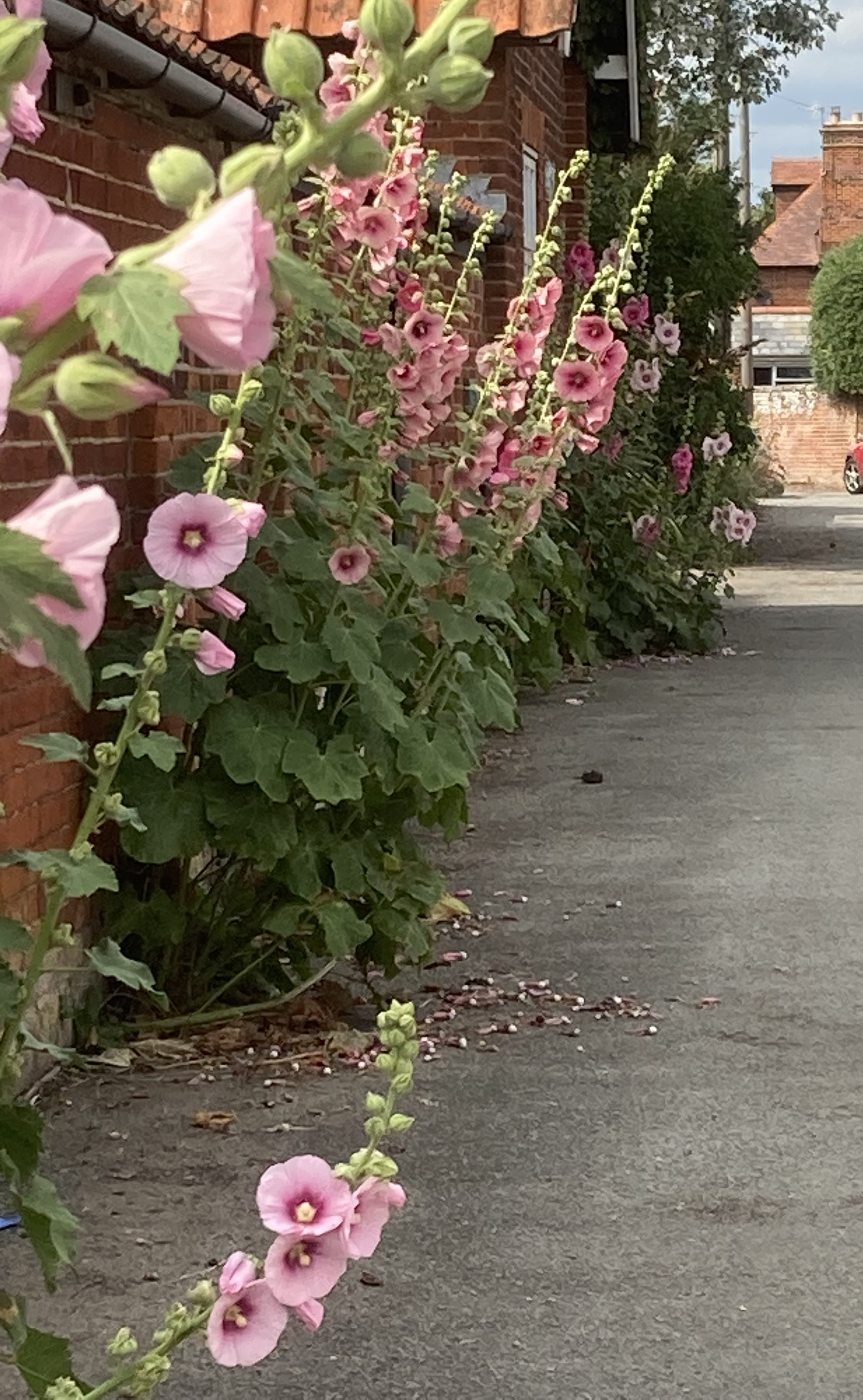
However, the tall hollyhocks of Aldeburgh have no need for horticulturalists. Any plant that can grow on Aldeburgh’s famous shingle beach can look after itself. Around the town they are everywhere, stems rising two metres high, displaying many coloured blooms from vibrant reds, to the palest pinks, soft peachy shades to a dark burgundy. They fill gardens and sway against brick walls along the road. It’s hard not to smile at this generous trail everywhere you turn. It starts in July when the first blooms appear towards the bottom of the stem. Flowers keep on coming up those tall stems right through summer, often into autumn. Though they are subjected to strong, salt laden East winds they return year after year.
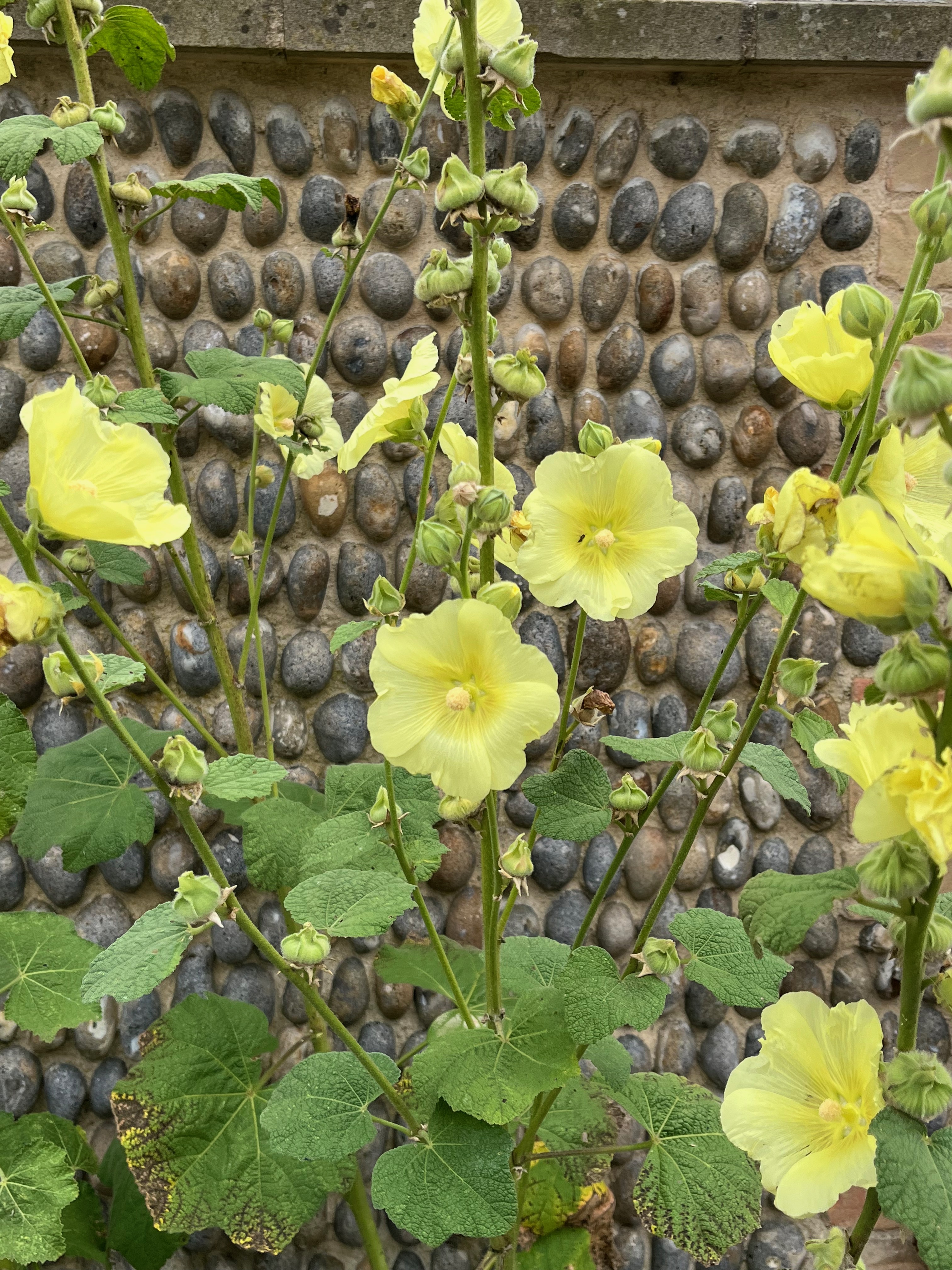
In our Aldeburgh garden hollyhocks have gathered over the 14 years we’ve spent there, my childhood jigsaw dream come true. They have arrived and arranged themselves with no help from me. I’ve sometimes collected seeds in autumn and scattered them but they seem to find their own preferred spot, most notably in the margin between the front wall and the pavement. The soil is poor, sandy, holding little moisture. They die back in late autumn then from late February new shoots and leaves begin to emerge in all the familiar places.
In April this year, I was dismayed to see that the several fresh plants emerging against our front wall were dying. It was clear they had been sprayed with weed killer. Who would do that? Back in Aldeburgh again in May the reason was clear – the council had resurfaced the pavement. That margin against the wall, which had allowed the plants to grow, was now sealed.
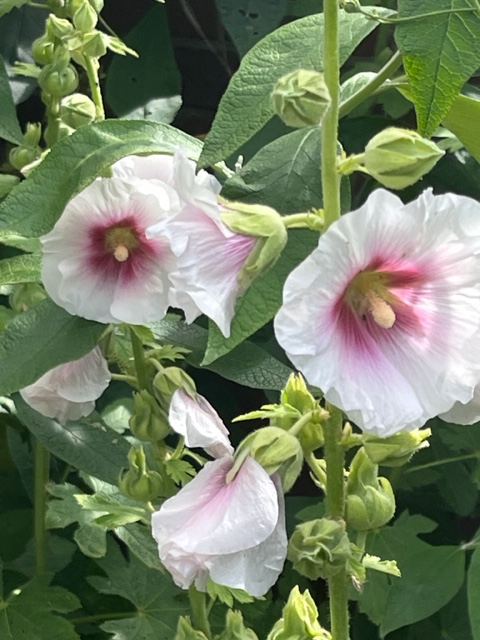

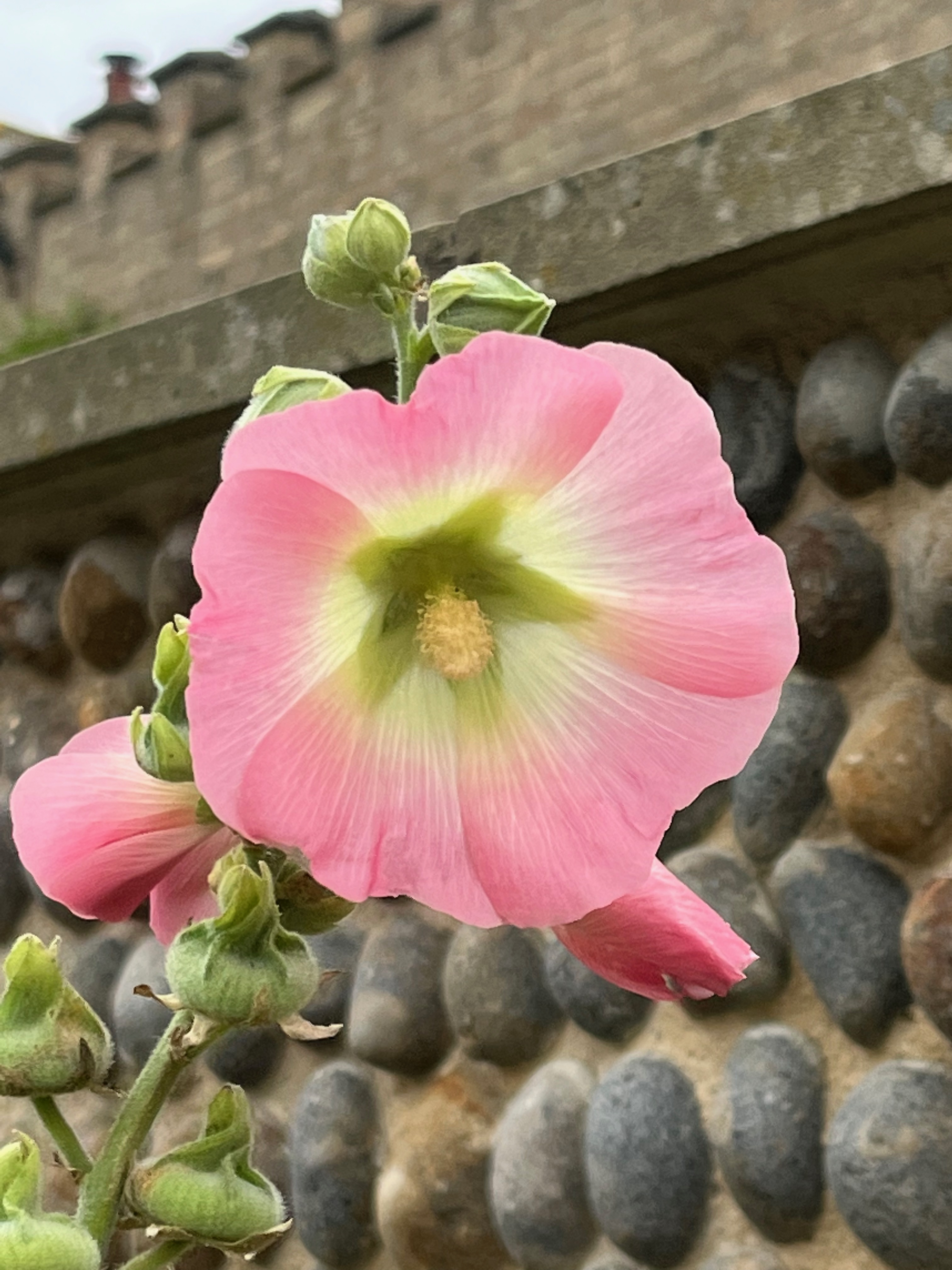
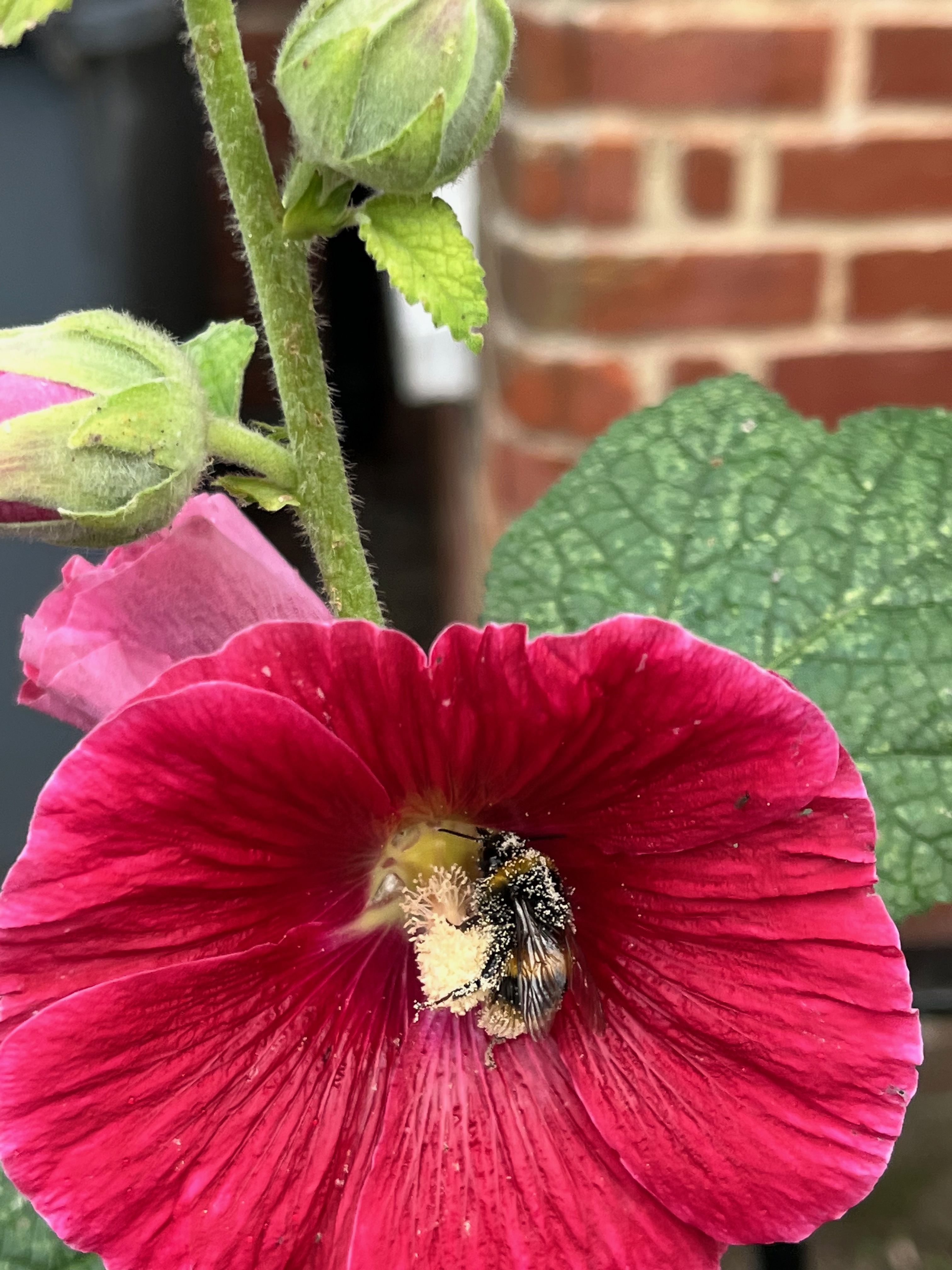
They come in many colours and bees love them
But at the beginning of August I noticed the shoots of six plants had found their way back through to the sun. It seemed unlikely they would bloom this year but clearly their rootstock had survived the poison. I had underestimated this determined plant. On 29 August one of the six produced a bloom.
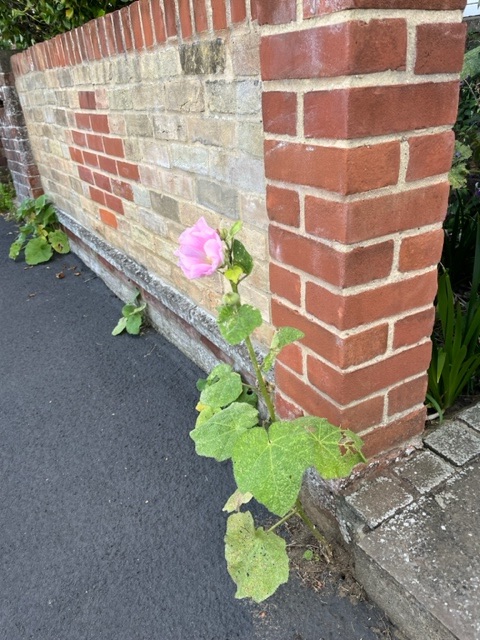
The hollyhock, this early migrant to our gardens and margins, adapts to wherever it finds itself. It requires not much soil, of any kind, in order to put down a root. It will then thrive on little water and few nutrients. It withstands floods, winds and even a plague of poison.
As the planet heats up this amazing plant is, for me, a symbol of the pure joy of being alive in this world but also a reminder of the need to develop resilience, flexibility and to take care of vital resources, to reflect on what it might mean to have just enough.
Pamela Johnson, August, 2023
 Blue Door Press