On the Eloquence of Bare Trees

Bare winter trees have fascinated me since childhood. Until recently, I would have said it was down to their beauty, to the pleasure of watching empty branches sketched against a winter blue sky or for the enjoyment of seeing the structure of things, a complexity made visible.

It took an iPad painting by David Hockney to reveal a further, surprising reason why trees have held my attention for decades.

*

I’m eight and beginning to understand that the world is a ball, spinning at a rate I can’t imagine. If it slows down we all fall off into outer space.

In my Church of England primary school the windows are high. Church-like. Looking up, I notice clouds moving against the sky and take this to be evidence of Earth slowing down. I daren’t tell the teacher – what words would I say? I make a plan. I will hold tight to one of the trees that grow in the playground. They are fixed to the spinning ball.  

Perhaps I soon realised my fear of flying off the planet was unfounded but memories of gazing up through that classroom’s high windows remain vivid. Soon, my attention shifted from clouds to the trees in their bare winter state.

There I am, bored by multiplication, finding it compelling and mysterious to study the way one branch, then another, divides and divides down to the finest twigs. I could have watched trees all day but for Miss Warburton nudging my attention back to the squared pages of my arithmetic book.

Later, at Grammar school, we had an inspirational art teacher, Mr Lofthouse – a real artist – who dressed casually and had a beard. In the Sixties, this was radical in a traditional Grammar school. Keen on abstraction, Mr Lofthouse encouraged us to study natural forms and to take our cue from these to make pictures that spoke of the world and how we felt about it, but not literally. How thrilling to discover it was possible to say things without using words.

I’m fourteen, about to start the end-of-year art exam. I turn over the paper to find several topics but couldn’t say now what the others were because as soon as I saw the words WINTER TREES, I was off. At ease, mixing shades of grey, creating with a few brush strokes a winding path to recede across the page, implying a sense of depth. Soon I’m not thinking how to do it, I’m lost in the flow, excited, urgently making marks to suggest a trunk, main branches and the pattern of finer and finer twigs.

Mr Lofthouse gives me a mark of 90%. He frames the piece and hangs it on the wall of the school hall. This is unusual, and a touch controversial. Not many people in this academic institution are as impressed as Mr Lofthouse and certainly not my parents. Art is a pastime not a serious subject. Why hadn’t I got 90% in History or Maths? For my parents, anxious, fearful people, my interest in art is disturbing. ‘I don’t know where she gets that from,’ they said as if I had a disease. I don’t know either. Perhaps it’s from my mother’s side? Perhaps she comes from a long line of artists? But she won’t reveal where she came from. We don’t know if she has any extended family. The fear in her eyes at the mention of relatives makes it clear we mustn’t ask.

*

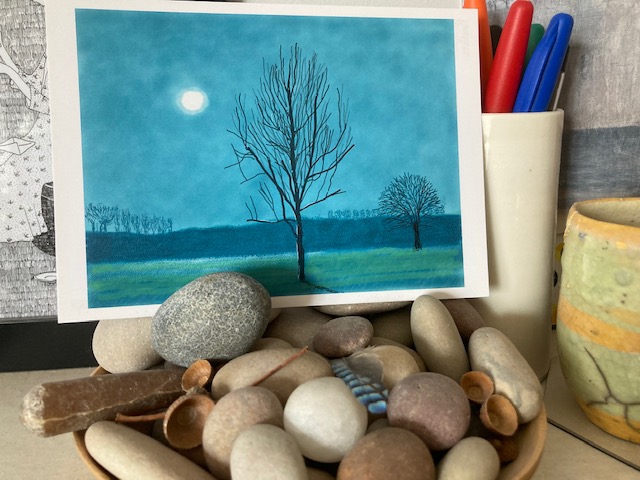
Since my mother died, aged 96, I’ve been researching and writing the story of her hidden past, a story I’ve needed all my life. Just when I feel I’m reaching the end of the memoir, my perception of my mother, her mystery and my view of it, starts to shift again. This happened recently while gazing at a postcard of an iPad painting by David Hockney. I’d seen the original in the 2021 exhibition, The Arrival of Spring, Normandy, 2020, at the Royal Academy. The exhibition was hung chronologically to give the viewer the experience of spring emerging. The piece titled, No 97, 5 March, 2020, alandscape of bare trees, lit by a full moon, was in the first room.

As other visitors hurry towards colourful works filled with blossoms and sharp greens, it’s in that first room that I linger, returning to it several times. This painting, for me, holds a charge. I want to lift it off the wall, to own it.

Instead, I make do with the postcard which sits on the mantelpiece in my workroom along with other postcards of Hockney’s winter tree paintings. But with this latest one, I find myself often stopping to enjoy the bands of colour suggesting a landscape at night. A translucent blue, stippled by lighter patches suggesting thin cloud, forms the sky. To the left, a circle of bright white depicts a full moon. Below the sky, a darker, thinner band of a solid bluish-grey forms a hill and in the foreground a band of green evokes a field, hatched with tiny touches of white along its edge where the moonlight falls.

Against the bands of colour, Hockney deftly sketches several bare trees. In the centre foreground a single large tree dominates, its branches reach up and inwards. To the right of the field and further back, so it seems smaller, is another lone tree. This one has branches that reach outwards.

As I study the relationship between the two trees I find myself thinking of the large one as my mother – fiercely independent, closing in on herself. The smaller tree, with the branches opening out, reminds me of myself, always reaching but getting no closer. Fanciful as that may sound, to me it feels right. Here is a representation of the years of longing to know what lay behind my mother’s secrecy.

The idea takes further shape as I focus on the rows of trees on the hill in the background. Those far off in the distance to the right suggest ancestors, long dead, but whose stories I’ve been colleting from the living relatives recently discovered. Could those people be represented by the group of trees to the left of the scene, under the moon and closer in? No wonder the painting felt charged. It encapsulates the mystery I have grown up with, the situation before I had words for it. Bare trees. A bare family tree.

Of course, what we notice, what snags our attention in the outside world, will have a connection to our inner world. As Hockney says, ‘we see psychologically.’ And hadn’t Mr Lofthouse taught me that years ago? The painting I made as an inquisitive fourteen-year-old no doubt said much about my state of mind at the time.

Thinking again about my eight-year-old self – perhaps those scudding clouds, my fear of falling into outer space, also had something to do with feeling unrooted, untethered. At least I could hold onto the trees. Bare trees offered somewhere tangible, to direct my curiosity for the intangible.

My new reading of Hockney’s painting is a reminder to look again at a work of art that won’t let you go – what might it be trying to say?

After the bleak winter of not knowing, my mother’s family tree is starting to reveal buds; the deep, wordless winter now edging towards the arrival of a kind of spring. As Hockney notes in the exhibition’s catalogue, ‘… to show the full arrival of spring you have to start in winter …’

Pamela Johnson March 2023
On Reading the Farm


I’m staying with my sister in Canada, find on a shelf one of my favourite books from childhood. One I read avidly (or so I thought). It was always my book: Jane’s Country Year. A young girl spends a year away from the city on a farm. I’ve carried an image of that farm safely through all those years, or thought I had.

I’m with my brother-in-law; we’re driving through Northern Alberta on our way to visit a real working farm. Our view is flat: sky, prairie, a few abandoned grain elevators. We’re going to collect furniture fifty miles beyond Beaver Lodge. I tell him what I’m expecting to find: a farmhouse in a green valley. Not this one, he says. It’s just a barn I rent.

But there would be a farm? He grunts, yes. He doesn’t seem curious about my book discovery so I don’t confess that I’ve already put it in my suitcase. Did any other story I read as a child have a farm? I read or was read to, and can vaguely remember a few things. There were themes the stories seemed to hold in common: an escape from somewhere not described. Out of the city? To the mountains or the countryside and security. Or Wind in the Willows. Follow Mole and be safer underground.

These were stories of houses, homes, burrows, cottages, farms, isolated in the countryside. Those accounts, those cosy illustrations of rural idylls, webbed into each other. Yet their content has slipped away leaving a sense of comfort in the strangeness. What did they add up to? A farm, a house I wanted as home – kettle on the stove, welcoming grown-ups, warm range, red-check table-cloth, jugs of milk.

He says we’re nearly there. I tell him that I’d just rescued from their shelves my favourite childhood book. He grunts. Our van bumps over potholes. Jane’s Country Year. I add that I’d remembered a cottage embossed in the centre of a green cloth cover but when I’d checked the cover I found it was not a cottage; it was a tree. So, not after all, a cottage deep down in a valley. He grunts again.

I’ve forgotten so much. When I found the lost book on their bookcase I’d remembered other titles that might have an image of that cottage, that valley. I’d googled and found an Enid Blyton with 1950s red-cheeked children: The Family at Red-Roofs. But this wasn’t the one I remembered where a wren was nanny to four children, making egg sandwiches. And was she really an overgrown bird? This one featured a cottage with red roofs but no chubby wren seemed to be catering?

Surely there was a farmhouse in a valley; there were barns and trees. I remember looking down from a height, that there below us was a house? I checked Jane’s Country Year again. It was there, inside, in an illustration. Not as I remembered it but certainly looking down at a valley, farmhouse, several barns. A year. Events like delivering baby lambs only came round once and then something else amazing to witness and then the child was gone away. Or did they invite her back? I must have checked the end of the story? I still could, now that I have the book. Or was it like Heidi with Grandfather? Seduced by the mountain slopes to go back and to keep returning. Whatever was left behind in the town was a longing and a blur. Or was it some threat that Heidi had to escape? Here and there, mountains, snow and a summer with the same vast extent of green.

Not magic but common sense. Down to earth. Like Mole and Ratty. There was food throughout that year, in all the stories. There was a journey there. And a leaving. But that was all right. While I was immersed in reading, it became my year in the countryside, nothing to do with ‘that girl’ at the centre of the story. A farm in a valley surrounded by the seasons, a range, a kitchen, a comfort. Each month accounted for.

As I started to read it again I realised I didn’t want to. I didn’t want to track down and re-read any of my childhood favourites. If I imagined myself back to that ‘Jane’s’ world, I might lose the security of that changing landscape. The warmth of hay in the barn. The cows swaying indifference as they crossed the yard. The steam popping from the cowpats. I didn’t want to relax any more in Mole or Ratty’s kitchen. What was it really like to be cuddled by Jenny Wren? Hardly comfortable.

The adults in the story didn’t consume the children but kept them fed and safe. It was a year that was built round that seasonal year of change. It was secure in the valley. As I read I could hear the conversations, I could hear people that sounded much like my imagined voices for Grandfather and Ratty as they described the workings of the farm. I was shown that countryside so it would never be lost to me. Always isolated, always in a green valley that surrendered to the seasons – bucolic, cows swaying their indifference on their way to the milking-shed. I was given the countryside as if that world was open to me.

That place was in a story, a picture and a feeling and all held in one year. The cycle. A small image embedded into the centre of the green cloth cover of a farmhouse and trees. Looking down from the height, there below us. Ok, it was actually just one tree embossed into the cover.

It was the year. Things only came round once and then she was gone. Or did they invite that girl back? I can’t remember and don’t want to check the book to see. Was it like Heidi with Grandfather, seduced by the mountain slopes? The same extent of green. Down to earth. Like Mole and Badger. There was food. There was a journey there. And a leaving. But that was all right.

My year in the country. All imagined. A farm in a valley surrounded by the seasons, a range, a kitchen, a comfort. Each month accounted for, it was such a long time that it stretches to now. If I go back there, I might lose the security of that changing landscape, the warmth of the hay heaped up in the barn, the cows’ udders swaying as they crossed the yard.

I was given a home in that book but I remember nothing about the young girl at the centre. She was probably too good and sweet to be true. It was the structure of the story that let me imagine my own adventures. It was secure in the valley but mainly I wanted to be back inside, in that warm kitchen. I didn’t always want the open road with Toad, I sometimes wanted to burrow down. Badger’s home in the middle of the Wild Wood would have been welcome.

My brother-in-law takes a sharp turn to the left. He says we’re there and I look out at yet more prairie. We rattle and bump down a track; a gate has been left half connected to a broken fence. We bounce and judder to a halt.

Suddenly I can see nothing. Not only is there no farm, no gentle cows, there is no anything. I don’t move. My brother-in-law has got out into a madness of mosquito and buzzing and is quite lost to me. There are denser shapes walking around that might be animal. A different buzz of energy seems human shaped, it breaks up into a couple who have come out of what must be the farmhouse.

They stand together in the front doorway in a daze of buzzing killers, their arms are crossed over their chests and they are watching. They seem sullen. I had started to get out of the van, not to be a coward, but am immediately covered and stung by these angry packets of hate. I get back in and wait while he loads up the back.

He does a thumbs-up to the blur that is the couple. They do not move; he gets into the van. You ok, he says?

I nod and we reverse, drive back down the track, take the road away to the town.

Jane Kirwan