Thinking about the phrase ‘Of Note’ while lying in the hammock, I was surrounded by birds making their presence felt, and remembered that birdsong can be more of a warning than a celebration.
Apparently the dawn chorus can record a brutal contest for territory much as the fighting described daily on the radio; this garden is in the middle of a Europe involved in another territorial war, a nightmare. A nightmare that’s being repeated globally.
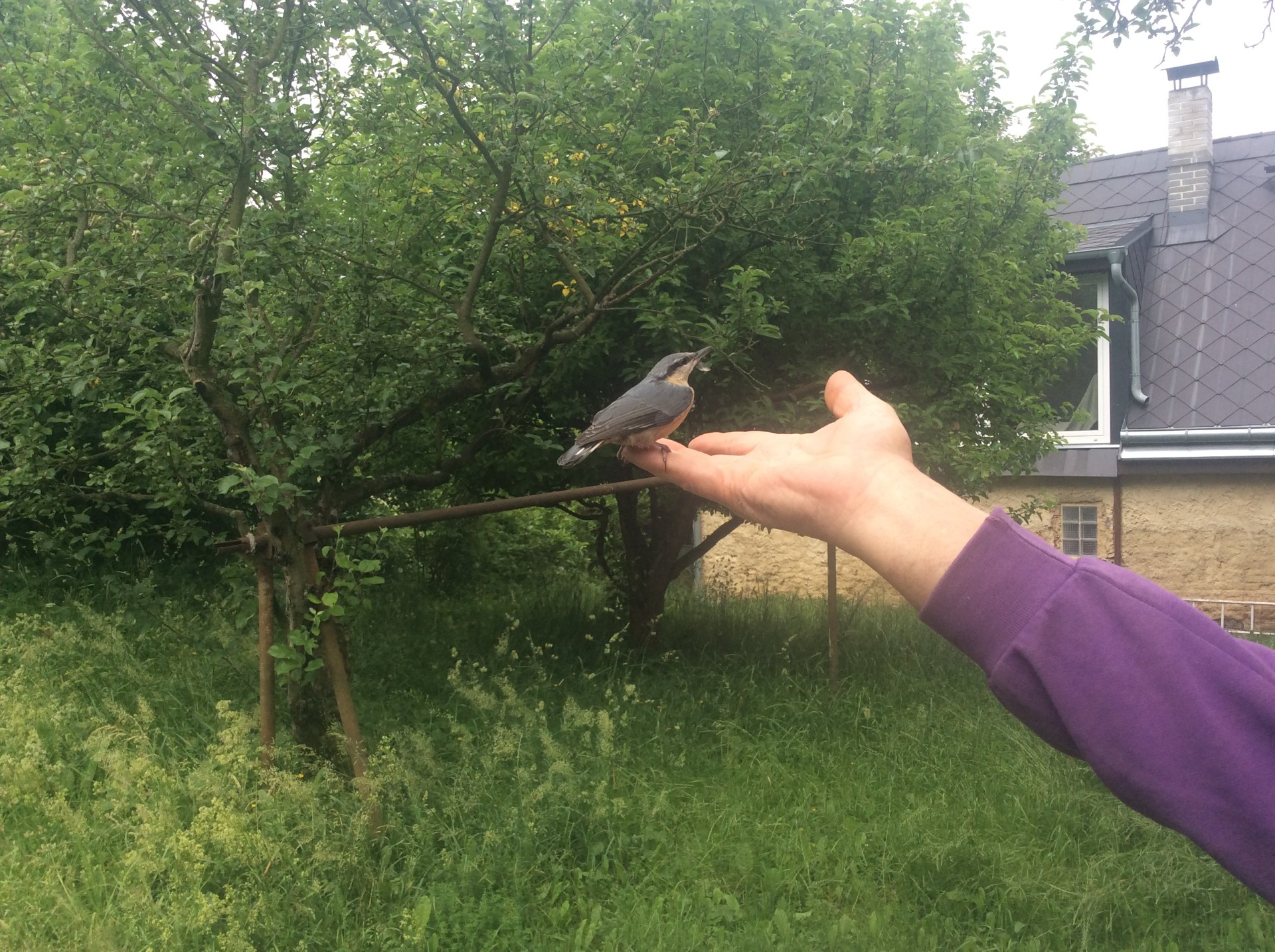
Meanwhile this bird has knocked itself unconscious on the glass window and was slowly recovering, so by listening to some shrill bird song while looking at one shocked but recovering bird this poem emerged.
Of course this bird has vanished from the final poem.
Of Note
A pause in the whine of combine mower chainsaw
a silence
then the same bird cry, a note so insistent
it’s a whistle from a neighbour a summons
not the butcher bird with its pouch of fledgling prey
not shrill enough for the shrike
whatever it is it’s something
that will soak the trees
then be quiet again sedate
and deadened
the restless flocks of starlings are ready
a shudder of wings
and there in the background
a circle saw
sense it this uncertain hour
the urge to close down
*
It’s a summons
from behind Novak’s empty house
or now, beyond Mrs Lorrydriver’s shed
an insistent whistle shifting away
nothing can lure it back
the cry fades they listen
they do nothing
yesterday they said isn’t it strange
to feel quickly detached from homes they’ve only just left
yet now, this call
they thought they had cut ourselves off
no twinge of guilt at their escape
ruthlessly snipping the strings then this bird.
*
Night is life, in technicolour, anxious and spluttering
without boundaries
caves of forgetting
under a goose-feather duvet
a cave is day day might have walls and no doors but a cave is day
a timetable for survival
for avoiding terror
while in night’s over-abundance of colour
all is activity and pleading
a world that’s neon-pink and glittering green
– though waiting in a train carriage, the thud of a bullet
is also night –
day is dark and located
it’s in that abandoned shuttered house
enticing
erupting from the body with an urgency that’s awe
as in part fear testing the edge the explosion
but concealed
turn of the lane nightdark
the day is dark the night the past
day returns to that house in the forest
no windows no doors
night blurred in a disco of jangled music
that house more than temptation
day the urgency to be there
*
On the distant bank are low buildings, the mill at Zvikovec,
dense red brick
inside those windowless walls: birches, larch,
outside is the roar of the weir.
Following the river, squelching through mud to swim, they ask
– do we want to be where we are?
Last night dreaming in a managed landscape
all the bits with power are
all the parts of our night-world are without power.
Inside those brick walls among the trees are landings, stairs, corridors.
These are the woods they walk in
or lying by the river
watching in the distance a heron paying attention. Quite still
silent there in the centre of the meadow
the heron staring beyond the weir. A long still wait.
*
The neighbour invited them for coffee. He didn’t know,
nor did they
his next July will become June, April slide into March,
young leaves crinkle to tight buds.
It was the back-to-frontness,
the cuckoo too early and sharp among the missing walnuts.
The blackbirds rootling
insisting on their rat-a-tat chorus until the very last light.
His gift to them of apricots, their drunken sway of lilac,
they didn’t know by sunset it will wither.
Not his nor theirs. This garden, orchard, forest. On loan
the empty hives, the hard-packed earth
the birdsong, the sharp note of the thrush.
That same bird cry, a note so insistent it’s a whistle
a summons
a shadow behind the fence.
The hoarse protest from his rooster, the honeysuckle
In 1970, when Nell qualifies as a doctor, she and her Nigerian boyfriend Jerome decide to leave London and the hostility they’re experiencing as a mixed-race couple. They move to Lagos; Jerome hasn’t been back since the Biafran war started in 1966.
***
Lagos 1971
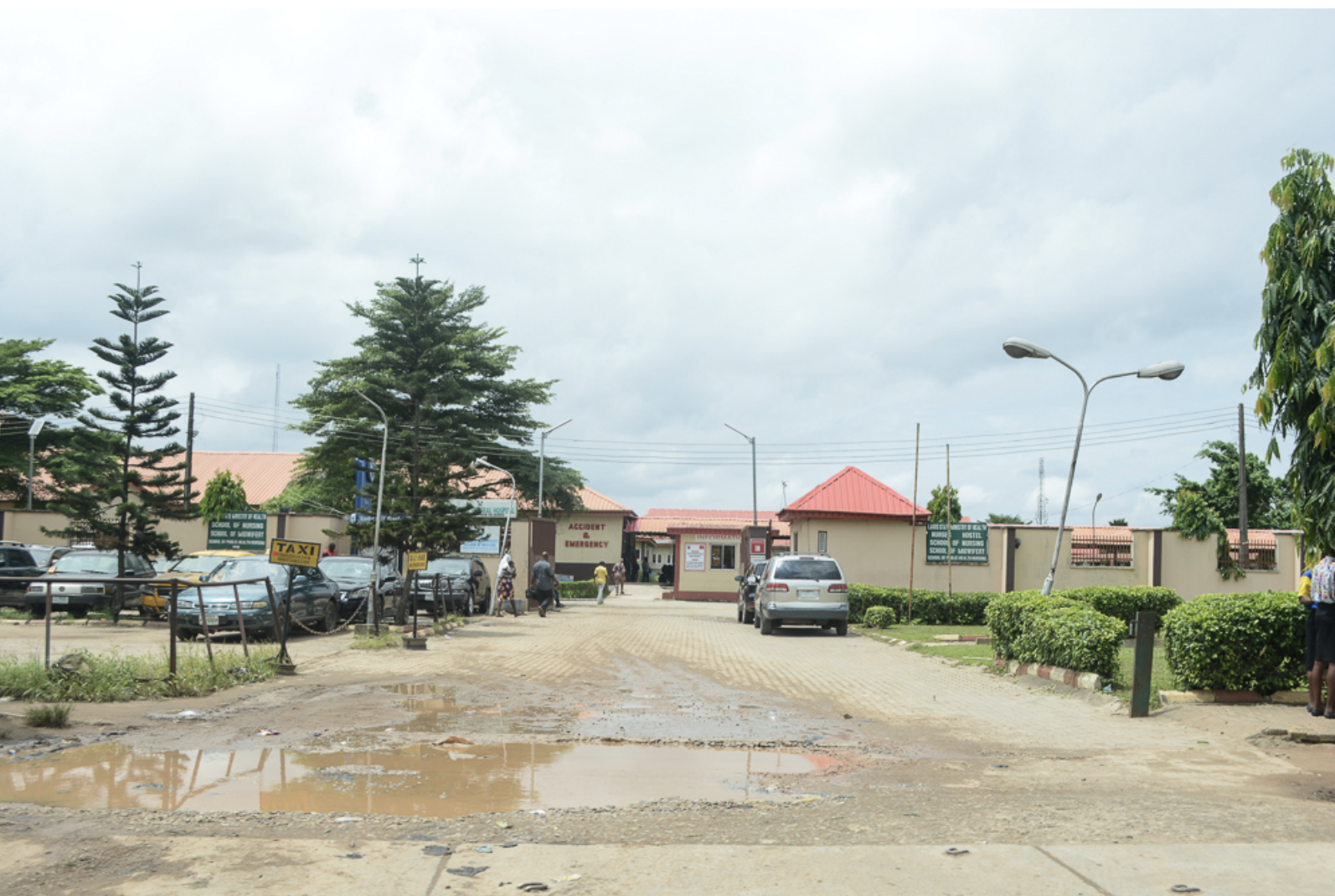
Jerome was slouched against the hospital gate near where the mini-bus would swerve to a halt. If they were lucky. Nell made herself look relaxed – thank goodness he still came to meet her.
Jerome straightened up and they hugged; ‘Was the day ok?’
‘It was ok.’
Nell backed away as a tiny boy stuck a basket inches from her face. Just before sunset, warm, no breeze, smell of rotting fruit. They’d do the long journey home, repeat it early in the morning. Soon, once Jerome’s job came through, she’d face travelling alone.
‘The nurses make it easy.’ Nell smiled at the boy and shook her head. ‘But this time Nneka couldn’t help – a man was staring at me with such venom.’
‘Oh, ignore those idiots,’ said Jerome.
‘It was pure hate, his gaze like ice. Nneka said he was a ‘Been-to’.’
Jerome kissed the top of her head, two small girls giggled.
‘So am I, Nell.’
‘I begged her but Nneka wouldn’t make him leave – she said he’d cause trouble.’
The boy was selling peanuts. Nell found a few kobos, bought a paper twist. The child was in rags – he looked exhausted. Not that they must appear so impressive, Jerome was sweating as much as her in the evening heat. They were both scarecrows; at least at work a white coat covered her shabbiness. Jerome was thinner than in London, his shirt patched, jeans worn out.
‘Did you meet up with Ifechi?’
‘I saw him and his smart new office,’ said Jerome.
Ifechi had come back just after the war ended and, like Jerome’s other contacts from London, proved elusive. When they’d first arrived, people confirmed Jerome’s years in journalism meant finding a job would be easy. He was given appointments for the final paper work – just wait a few days. Slowly, hideously, the offers melted away. Whoever promised it, disappeared; suddenly no one knew anything. At least the hospital had given Nell sessions so they could pay the rent. The flat had been hard to find; they were lucky, but it was miles away on the Kiri Kiri road, the other side of the city.
‘Apparently Ifechi got married as soon as he arrived, has a couple of children.’
Jerome didn’t sound envious, just resigned. Thank god they didn’t have a baby. The boy tilted the basket to show Jerome but Jerome was tougher than Nell, brushed the child away.
They crammed into a space by the door of the packed minibus, its sign In God We Trust; after a while they’d have to change, trust another god. Jerome took her hands. ‘Ifechi wondered if we’d really thought things through?’
‘Oh, great help.’ Nell frowned at the blocked road. Nothing was moving.
Maybe Ifechi had also asked if she might have pressured Jerome to return. She wouldn’t suggest that.
She wriggled herself nearer the door, grabbed Jerome’s arm.
‘Let’s get out, it’ll be quicker.’
The buses were always packed, the other passengers checking her like some pathology specimen. At first, she’d complained, ‘have I got horns?’ but soon stopped bothering. All that mattered was finding a space and for the mini-bus not to get stuck in a jam or change its mind and accelerate off to a more profitable route.
Walking was a crazy idea. There was no path for pedestrians; on one side was a stream with sewage and rubbish, on the other the kamikaze drivers: lorries, buses, vans, revving up to the next jam. Everyone used the centre of the road because the potholes at the edge were lethal. The din as drivers sat on their horns, the screeching brakes and tyres.
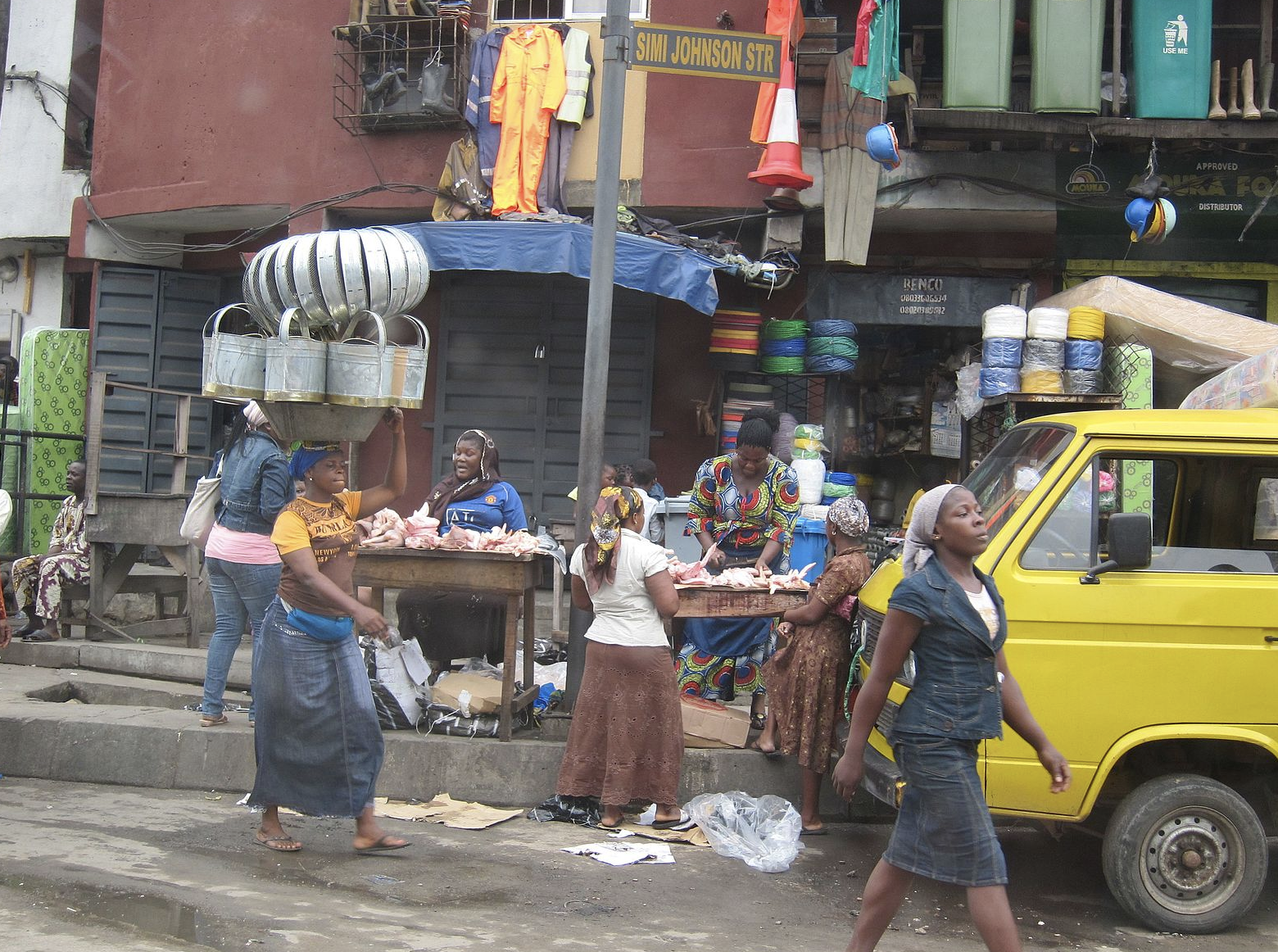
Jerome was ahead, almost jogging. A motorcycle missed her by inches as she avoided a couple of emaciated cows being cajoled to the slaughter-house. It was clear from the beginning she should stay this side of the ditch; the shacks, kitchens, and stalls were the same as the miles of living space they’d first witnessed six months ago on the journey from the airport. Not their land, they’d be trespassing; each square foot was accounted for: huts, tea-chests, boxes, tarpaulin hooked over ropes, shells of abandoned cars. Villas for the less affluent – old suitcases, tin cans, marking the boundary of each bathroom, kitchen.
‘Jerome,’ she yelled. ‘Slow down.’
The women standing over stoves had been working since first light. It was mostly children who carried water – tottering miles balancing rusty pails on their heads. One infant, she decided, couldn’t have been more than two, water from a chipped enamel basin spilling on the red dust.
At last Jerome joined her. A couple of boys screamed ‘Oyinbos’. Being called a foreigner infuriated him.
‘Let’s have a treat,’ Nell said. ‘You’ve met up with Ifechi: he might help. Let’s get the bus at the roundabout, go to Kingsway, admire the clothes.’
To her surprise, he agreed.
A blind child was begging outside the department store. A skeletal woman, a toddler swaddled to her back, watched as they kept to the shadow of the buildings.
Nell breathed in the stale, cooled air.
‘It’s quiet as a morgue,’ said Jerome, taking her hand.
‘Did you give them money?’
‘What do you think? I wrote a cheque.’
They wandered through the clothes section: neat rows of shirts, carefully arranged scarves, racks of jackets; everything looked irrelevant and grey compared to the colour and chaos of the street markets. The cool musty air might be comforting after the heat but this was dull compared to Ajegunle where they normally shopped. There, the stalls were packed together: tinned milk next to maize; meat beside plantain then rolls upon rolls of material in vivid colours, an abundance of patterns. On a tiny piece of land by a stall of yams, someone would have set out shoe-laces or a couple of tin plates on a rag. Often the only space to walk was the channels of contaminated water trickling into the ditch.
Two nuns stood at a counter in animated discussion over a pair of socks. They must be baking in their heavy habits.
‘Let’s share a Coke,’ said Jerome as they went towards the escalator.
‘This place is unreal.’
Jerome took her arm. ‘And you relish it.’
.***
It was months before there was any contact from Ifechi and it wasn’t news of a job but an invite to go swimming. Ifechi wanted them to join him at the pool in the Federal Palace Hotel. It was glorious, water slapping gently against the blue tiles; Nell shut her eyes. Wafts of jasmine. August. In England it was probably raining. Blissful to be here. A midday African sun hit the reflections and she sheltered under an umbrella.
‘Why not get in, Nell?’ said Ifechi.
Her swimsuit was tatty, and anyway it was heaven to stay in the shade, admire Jerome doing front-crawl, ploughing his way through more relaxed swimmers. Ifechi poured a cola slowly, watching it drip into the spaces between the ice cubes. He offered it to Nell, she shook her head.
An overweight, unfit, middle-aged man, this old friend from London, from before, was meant to be Jerome’s most important contact. But Ifechi was unsettling. Jerome insisted he had nothing to do with the vanished job but he looked shifty, and he flirted.
‘Are you homesick?’ said a beautiful young woman. She’d arrived with Ifechi and another woman, and a gang of children.
Nell must be coming over as some kind of misery. ‘No, no, really. I love it here.’
The two women were fascinating; chatted easily to each other or to Nell but when addressed by Ifechi, refused to answer. Instead they sat back and mockingly admired him. Ifechi clearly found this infuriating. Better not notice how charmed Jerome seemed.
‘Ifechi is publishing a few more magazines,’ Jerome had muttered when they arrived. Well, that might be helpful.
A couple of the tiny children splashed out of the pool, landed themselves in Ifechi’s lap. He hauled one up, swung it in the air. One of the women frowned, brushed water from her swimsuit.
‘Are they all his children?’ said Nell.
‘I guess,’ said the younger woman. ‘Ifechi has several.’
‘Really? Which of you is their mum?’
The girl smiled, patted Nell on the leg. ‘She’s not here.’
Nell winced at herself. What an idiot.
Jerome pulled himself out, dived again into the water, a clean and perfect arrow that just missed two men.
‘Foolish boy,’ said Ifechi. ‘Well, that’s good that you feel at home.’ He wiped the moisture from a glass of cold beer and offered it. Nell shook her head.
‘Star beer. Not your American rubbish.’
‘Not my American.’
‘Don’t get cross. I love Jerome, truly I do.’
She must try to be agreeable. ‘I like the Star ads.’
‘Ah, the movies again? I love the movies.’ Ifechi made a gun with his fingers, took pot shots at the sunbathers.
‘This is a film-set.’ Nell gestured to the ornate tubs overflowing with flowers, the poolside bar. ‘Or an advert.’
Going to movies had become a treat, a rare one they couldn’t afford. The films were usually American gangsters but the ads were made locally. Lagos was a set where beautiful couples drank beer, smoked expensive cigarettes, drove sports cars and wore Western or Nigerian clothes. Nell went mainly to see the ads: the roads were empty, the water lapping the shores of the harbour uncontaminated with rubbish, oil, sewage, dead dogs. Colours were extra intense making up a world which could be day-dreamed into, and it was here. The other doctors chatted about nightclubs and Highlife. Theirs was a world she and Jerome couldn’t quite get to. None of it. No sitting drinking beer as the sun went down, the right camera angle, lazy long shot.
Jerome was doing a perfect crawl down the length of the pool. He swam so beautifully. Ifechi caught Nell’s eye. He was going to be no help to Jerome at all.
***
The miles of interweaving lanes were unlit, no moon. Nell and Jerome were lost. They clutched each other, could barely make out the path.
‘I never thought of a torch,’ said Jerome.
They were late for Nneka’s party. They’d been to visit a couple Jerome met through Ifechi; supposedly their house was in the same part of Lagos, but they got lost going there and lost coming here.
Jerome was still uneasy after the visit, the man was Hausa and had been intimidating. He was angry at having to wait for them and quickly took Jerome off to his study for a drink. His German wife, Ilsa, looked exhausted. As she took Nell to admire the house, the irritating children, she seemed increasingly uncomfortable with Nell’s questions about life in Lagos.
‘You will get used to it,’ she said. ‘Jerome will help.’
‘We’ve been here two years and I know no one, except at work.’
‘It takes time,’ said Ilsa. ‘And having children helps.’
Well that wasn’t about to happen soon. ‘Jerome is bored with my moans, wants me to be positive.’
Nell was about to tell Ilsa about the small boy in the clinic that morning. Jerome would have stopped her if he’d overheard. Ilsa interrupted, muttering that she should go and organise coffee, see what her children were doing. Nell waited in the garden, taking in the silence. Silly to think people would want to know. No point confiding in anyone about anything, let alone that patient. No point imagining anything she could have done differently.
He’d been sitting in a corner of the cubicle resting his hand lightly on a woman’s knee, making no demands. He had his back to the room, was probably about three. His head was slightly tilted as if he was tired, soft black curls resting against the creamy skin of his neck.
Nell had wanted to delay everything. She could run her fingers up his spine, tickle his hair, but she made herself crouch in front of the boy, read his notes. His mother’s expression was blank – she was staring at the wall.
The patient looked at Nell, his huge eyes cautious. She smiled back. His nose was snub and smooth. His lower lip trembled slightly. Where his left cheek should be was nothing, a cavity with no skin or flesh; it exposed the inside of his mouth, his teeth, his pharynx.
The mother knew the loss was irreversible, its progress inevitable, triggered by malnutrition. Nell would give him a pointless injection of penicillin, send him home. The mother would carry him for miles.
How could any woman do that, watch her child die day by day? And so many like this coming to the hospital for a miracle. As Ilsa came into the garden holding out a grizzling baby, Nell knew she’d never have children.
Jerome was as out of place as she was. ‘We’ll be late for Nneka,’ he said.
At last, by following faint traces of music, they found a gate set into a wall. In a large space circled by small huts, people milled around a central pool of light. Nneka looked luminous. Gold earrings, necklaces, bracelets, gold threads studded with gold beads braiding her hair; chains of gold circled her wrists, ankles, neck. She wore a lemon brocade waistcoat over a lemon satin dress, carried a small chest already overflowing with naira. As she greeted each guest, notes were stuffed among the others.
‘You should have warned me about the money.’
‘She’s your friend.’ said Jerome. ‘Is it really only her birthday?’
After handing over their gift – a scarf from Kingsway – shaking hands with numerous strangers, they sat on one of the benches. Young children ran around handing out cold beer and soft drinks. One of the tiny ones stopped, grabbed Nell’s leg. Nell hauled the child up to her lap. How good to feel the girl using her like an armchair, letting herself be cuddled.
‘That toddler suits you,’ said Jerome.
Was that what might happen? She’d end up exhausted and drained, have several rough children, and Jerome away enjoying himself with Ifechi? And if the children got ill? No, the thought was inconceivable.
Oil lamps had been strung along wires between posts. Nneka and her family walked among the guests, in and out of the light. People had started to dance. Reflections spat and shimmered – not just from Nneka’s gold, most people were wearing lavish jewellery.
‘We’re so drab, Jerome.’
Nell kissed the top of the child’s elaborately plaited hair, the girl smelt of rose-water. The women wore expensively designed wrappers and the men, Jerome the rare exception, were in embroidered agbadas, mostly full length with matching pants. Guests were still arriving, picking their way along the same muddy lanes.
Dishes started to appear, Nneka brought over chicken and rice.
‘You look wonderful, and such a wealth of presents,’ said Nell.
Nneka shooed away the small girl.
‘Oh, no, Nneka, don’t.’ Too late to stop her.
Jerome finished his food quickly, handed Nell the empty plate. ‘How about more? Fast as you can.’
‘And, if I don’t?’ said Nell.
He was showing off in front of Nneka. All of this, the extended family, the party, the glamour, this crowd of people enjoying themselves, was upsetting him. He’d been disturbed by the couple they’d just visited, but Nell could do nothing; she couldn’t conjure up any family, neither apparently could he.
Nneka grabbed her arm. ‘Come, Nell, let’s get the man more chop.’
As they reached the cooking area, Nneka said, ‘You shouldn’t talk to Jerome like that.’
‘He shouldn’t to me.’
Everyone criticising. Why had Nneka sent away that child?
An elderly man joined them, Nneka introducing him as her uncle. ‘Go and dance, Nell. I’ll take the food to Jerome.’
When Nell left the dance-floor, tired but slightly happier, Jerome was gone. He wasn’t at any of the tables where people were slicing cake, carving up chickens, collecting cans of beer. Where could he go? He’d disappeared. He’d been as lost as she had.
There was a dark corner where she could make herself comfortable, watch the entrance and bench where they’d been sitting. Nneka was having a subdued row with a large older woman in red silk; whenever she paused to listen, the woman tugged at an ornate silver necklace. At one point, Nneka reached across, gently touched it.
As the hours passed, people drifted off. A few dancers stayed with the music, a couple giggled in the shadows on the left. Wait till dawn, find her own way home, but the night was never-ending. She must not cry.
Nneka didn’t seem surprised to see Nell appear, didn’t mention the absent Jerome. ‘Come and meet my mother.’
The woman in red was boiling water on a stove in one of the huts; she beamed a welcome. The room smelt of coffee. Nneka filled a few mugs and her mother added dollops of condensed milk. ‘Mary, give out the cake, I’ll be back,’ and the mother was gone.
‘Mary?’
‘Yes, and what of it?’ Nneka handed Nell a slice of date sponge.
‘She was giving you an earful.’ The coffee was very sweet.
‘She wants me to find a man, have children.’
Nneka had once told her that her mother had left their village during the Biafran war, come with them to Lagos to find Nneka’s father. By the time they’d got here, he was dead. No money. No support. Three young children. ‘The nuns helped us.’
The sweet drink and rich sponge were too much; it was so warm inside the room, some lilac perfume mixed with the smell of coffee. Nell could barely make out Nneka’s face; it would be wonderful to sleep. Then she remembered why she felt terrible – Jerome had vanished.
Nell woke to the sound of muttered voices. It was still dark, Jerome was back, standing under a lantern by the door, talking to Nneka and a lean woman in a blue suit. Should she interrupt them? He looked relaxed, was enjoying himself.
Two toddlers were lying on her legs. The blanket felt comforting, the children fast asleep and heavy; there was gentle snoring from the far corner.
There was laughter from beyond the entrance. A bright light flashed through the open door, blinding Nell; one of Nneka’s cousins burst in holding a lamp.
‘Oh, I’m beyond tired! Lord save us.’ The cousin tossed her shoe into the corner.
The snoring shape grunted; Nneka’s mother lifted her head from the mound of blankets, threw the shoe back. The cousin clutched Nneka, and both shook with laughter. Nneka’s gold-braided hair flashed in the light, some of the strands were coming undone. Their hug turned into a dance, they looked glorious.
Nell managed to push the children away. She stood up and touched Jerome’s arm, tried to sound calm. ‘Where were you?’
‘I went to meet some relatives,’ said Jerome.
He had never mentioned relatives.
Biography
Jane Kirwan has published three poetry collections, Stealing the Eiffel Tower (1997), The Man Who Sold Mirrors (2003), The Goose Woman, (2019) and co-authored Stories & Lies with Pamela Johnson and Jennifer Grigg. She won a Arts Council Writers Award in 2002, published a prose-poem collection Second Exile with Ales Machacek (2010), and Born in the NHS (2013) with Wendy French. In 2016 she published a novel, Don’t Mention Her.
 Blue Door Press