OF NOTE: Big Books and Other Overly Long Things

I’ve been enjoying writing the smallest of texts – children’s poems. At the same time, I’ve been reading fiction for my own pleasure, for my book group and also, a fairly recently joined French reading group. These experiences have led me to think a lot about size and length of texts –  in fact the size and length of all cultural creations, including concerts, plays and films, even mini-series.

Perhaps it’s just that I’m getting older, the clock is ticking, bedtime has never looked more inviting and can’t come soon enough, and coping with something that goes on and on, however good, feels increasingly hard. This is especially so if it is not stunningly high quality and utterly riveting. Whatever happened to the ruthless editor, who stripped out unnecessary guff? Gordon Lish, Raymond Carver’s editor, famously slashed his stories, in one case by 70%, in many others by over 50%.  At one point Carver wrote to Lish,

‘I can’t undergo the kind of surgical amputation and transplant that might make them someway fit into the carton so the lid will close.’

As it turns out, he could and did, and his writing was all the better for that.

It is said that Ezra Pound cut T.S.Eliot’s  ‘The Waste Land’ in half.  Some writers, of course, are their own demanding editors. Diana Athill is quoted in The Guardian (Sept 16 2000) saying of Jean Rhys,

‘what she aimed for was ‘getting it right, getting it as it really was’; and that one must cut and cut and cut again.’

Rhys’ most well-known book, Wide Sargasso Sea is one of my favourites of all time and is a miracle of tight construction, brevity and the richness that comes from honing and refining rather than indulging in an expansive splurge of ideas.

So back to my current reading for pleasure, and here are a few observations. Lots of contemporary novels seem to me to be far too long, particularly those by writers whose reputations assure them publication. Reading Maggie O’Farrell’s The Marriage Portrait and Barbara Kingsolver’s Demon Copperhead I longed for a bit more restraint – fewer episodes, less description, a little less banging the reader on the head with a large hammer, saying ‘pay attention to my messages’ in the case of Kingsolver, or ‘look how much research I’ve done and how beautifully I can write’, in the case of O’Farrell. I loved Hamnet but honestly, in The Marriage Portrait there’s a limit to how much poetic description of 16th century clothing I can take over five hundred pages of a narrative text. Kingsolver was, of course, trying to evoke Dickens, who wrote famously big tomes. But there are a few major differences. Dickens was a master of light and shade, managing to entertain with humour, caricature, evoking multiple voices and swings of fortune, bringing the reader with him as he made his points about justice, wealth and poverty and human behaviour. Demon Copperhead tracks David Copperfield but, for me, without the same lightness of touch. It is social comment rather than satire, and has a relentless grimness that is hard to live with over the many hours it takes to read.

I could say the same about films and theatre. Several trips to the National Theatre to watch new plays have started with a sense of excitement and promise, and ended with a wish that at least half an hour had been shaved off by a Gordon Lish-like director. In particular, in my view, many contemporary playwrights need to ask themselves questions about what happens after the interval (or sometimes, sadly, intervals). All too often, the play seems to tail off, flap around a bit and then end in a disappointingly lame dénouement. Arthur Miller and Tennessee Williams, and one of my personal favourites, Sam Shepherd, knew exactly how to ratchet up the tension and end with a punch to the gut. I want to go away wishing it weren’t over, rather than longing for the end to come!

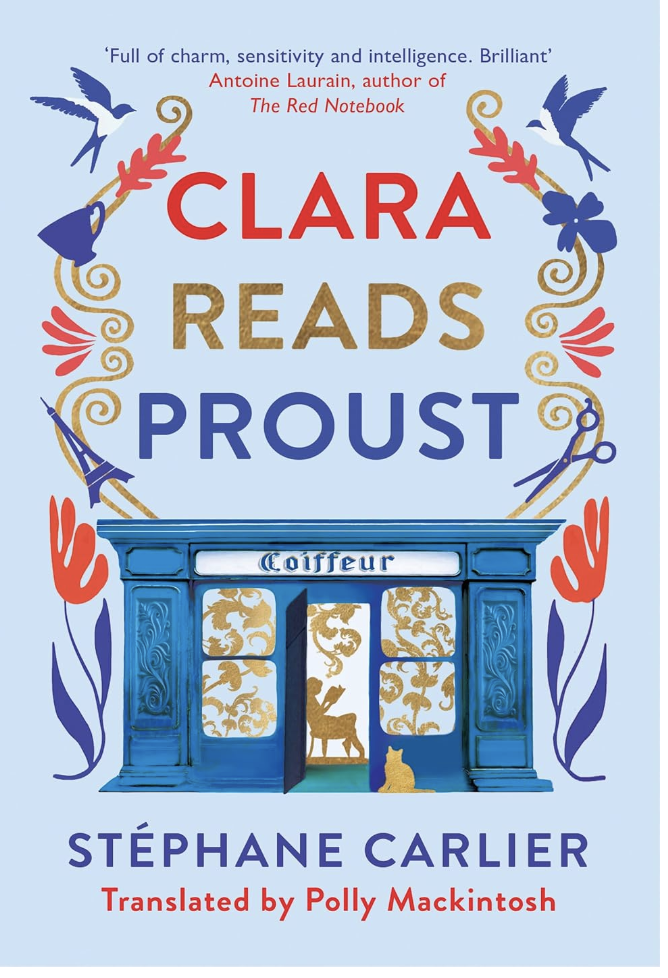
By contrast, the contemporary novels that I have been reading for my French reading group have all been short ones – we’ve deliberately imposed a strict page limit on our choices, to allow for the struggle of reading in another language. And my goodness what superb writing we’ve encountered! Perhaps there are also contemporary French novelists who are churning out doorstops but the ones who are not are absolutely first rate. Clara Lit Proust by Stéphane Carlier (192 pages) is a marvellous book about the power of reading, rather unexpectedly but brilliantly set in a hairdressing salon. Likewise, with novels by Amelie Nothomb, Philippe Besson and Faïza Guène, among others.
There are some exceptions to this, of course, and perhaps I could now be accused of making differential rules for books I happen to like or not. But I think there has to be a strong rationale for excessive size. Family sagas, some historical novels, books grappling with complex material would come into this category for me. So, for instance, Apeirogon by Colum McCann is a highly original and complicated exploration of the Israel/Palestine question, with one thousand and one short sections mirroring The Arabian Nights. There’s good reason for its size. And Paul Murray’s The Bee Sting is a fabulously written story of different generations of a family, bringing in different perspectives and surprising revelations right up to the very end.

What about personal essays and their length? I’ve hit nine hundred words or so now. Too long? Too wordy? In need of a good editor?  I’ll leave that to you to decide.

Barbara Bleiman

September 26 2024

OF NOTE: Lured by words

I’d wanted to visit Trieste for over 20 years, since reading Trieste and the Meaning of Nowhere by Jan Morris. During those two decades, other cities got me first, more obvious places, like Venice. But Trieste had lodged itself in my psyche, its name alone igniting longing: triste means sad in Italian. And the addition of the extra ‘e’ seemed to perfectly evoke the city Morris described as being ‘almost like an ecstasy of the poignant.’

I pictured it like a de Chirco painting, with vast piazzas, majestic yet empty, its past grandeur, as the Austro-Hungarian empire’s main seaport, now faded. 

But when we arrived, from the nearby Slovenian border, it seemed like so many other bustling European cities, with its wide boulevards, flanked by nineteenth century apartment buildings with pasticcerias and farmacias at street level, and its narrower, winding backstreets. Where was the otherness Morris had so beautifully described? 

I first encountered it the next day, at Miramar, a castle built from white Istrian stone, on a promontory at the city’s western edge. It was the love-project of Maximilian, the Hapsburg Duke, who created it for his young bride, Carlotta. A home they inhabited only briefly, before being posted to Mexico, where Maximilian was later shot dead. Standing in its luxurious and still pristine rooms, overlooking the blue Adriatic, I sensed the ache of abandoned dreams, of life’s unpredictability. 

I found it again as I meandered through the city: in the quiet of its vast main square, Piazza Unita D’Italia, with its imposing civic buildings and mere scattering of people, its fourth side giving way to an expanse of sea. And in the cool, dark interior of one of the world’s most beautiful cafés, Antico Caffè San Marco, its glass cabinet filled with Sachertorte, Apple Strudel and the latticed crust of Linzertorte an ode to Mitteleuropa. And where, on a Thursday lunchtime, a mournful-lookingman in sunglasses drank white wine at one of the few occupied tables. 

And, finally, I found it standing in a chapel, perched on a hill above the city. We’d been intrigued by its concrete form, visible from the promenade, and shaped like a truncated pyramid. We hadn’t expected a 45-metre high space, some fifty thousand feet in volume. Nor to be the only ones there on this June afternoon. 

Would I have experienced its otherness had I not read Morris’s book? Possibly. But the beauty of words and stories is they hold the potential to resculpt our vision, guiding us towards what we might otherwise have overlooked. 

Annabel Chown, June 2024

What Makes a Successful Book Group?

I’ve visited a number of groups to talk about Taking In Water. Most memorable was a visit to the Luton Women’s Book Discussion Group. I was curious to know how they’d kept going for over thirty years, so asked a few questions – fiction, feminism and food are at the heart of it …

Book group 2

PJ: How did it all begin?

The Group: We grew out of one of a number of Women’s Groups which met in Luton during the early 1980s. One initiative in 1985 was to create special interest groups alongside the smaller Consciousness Raising groups. Book Group was one of these. We did arise from the ideology of the Women’s Movement, and a belief and interest in the principles of feminism have continued to remain fundamental to our approach. We’ve met eleven times each year, starting in December 1985. The pattern of a monthly meeting on a Thursday evening with a break in August, has continued since.

PJ: Do all current members go back to 1985?

The Group: Five women who attended the early meetings continue today alongside other longstanding and newer members. Sometimes the group can barely fit into the room and sometimes it’s tiny. By and large it seems to self-regulate and usually we have a core group of about twelve.

Book group1

 PJ: You only read books by women – no exceptions?

The Group: We’ve always met as a group of women to discuss books written by women. This doesn’t mean, as some critics have suggested over the years, that we reject or ignore literature by men. Most of us read books by both men and women outside the group and books by men may well be cited in discussion. However, we remain a group of female readers who believe that, more than thirty years after our inaugural meeting, we still live in a society where there’s sexism. By maintaining a focus on women’s literature we’re doing something to counter a male-dominated view of the world. In this context, at least, we pay attention the voices of a diverse range of women writers.

PJ: How do you choose your books?

The Group: We choose books two or three times a year. One principle we’ve adhered to is that all books should be readily available in paperback, so not too expensive, although many members order them from the local library. We note down books that interest us and throw them into the pot, sometimes supported by a clipping or a review. A consensus emerges through discussion. We’ve read around 345 books over the years, predominantly novels. But we do incorporate non-fiction, usually biographies and autobiographies, sometimes books about feminist theory. We’ve read The Second Sex by Simone de Beauvoir and The Beauty Myth by Naomi Wolf and, more unusually, The Immortal Life of Henrietta Lacks by Rebecca Kloot, which deals with racial discrimination and scientific developments in the US. We do our best to include a wide range of cultural perspectives. Not all books are popular and some such as Dolly City, an allegory about the creation of Israel, have been regarded as unreadable. The best discussions to seem to be generated by books which divide opinion

PJ: Have you noticed a shift in your interests, over the years?

The Group: It would be interesting to analyse to what extent the books have reflected our own changing life stages. There was a phase in which we reread some of the classics of our childhood such as Little Women and Black Beauty. The latter proved a grave disappointment. We have reappraised classics that we had mostly already read such as To Kill a Mockingbird which did not disappoint and Wuthering Heights which did. Now that many members have retired, we are less concerned by the number of pages and more able to take on a lengthy read. We’ve never been successful in incorporating poetry despite a number of attempts at poetry evenings. This has never generated a coherent discussion though, interestingly, Elizabeth Barrett Browning’s verse novel Aurora Leigh was read and appreciated.

PJ: You have a strong identity with your book lists that are mailed to non-members

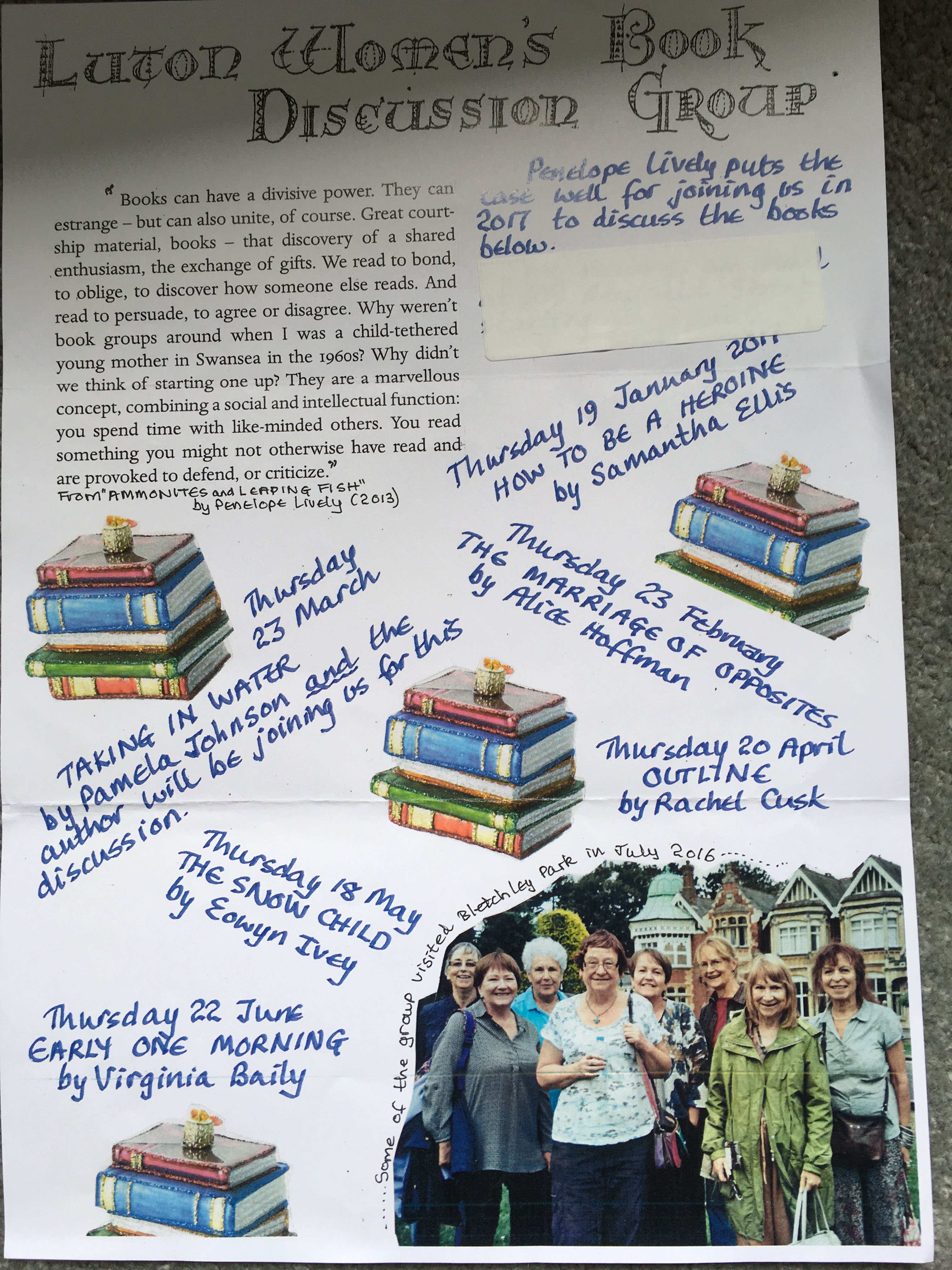
The Group: One member produces a distinctively illustrated list of the books we are going to read over (usually) a six-month period. It’s a feature of the group that’s remained consistent over the years and promotes our sense of identity. The list is also distributed to a number of people who could loosely be categorised as ‘Friends of Book Group’. These include members who have moved away and friends of members who cannot attend but remain interested in what we are reading.

newsletteredit

PJ: Tell me about your Christmas meeting – I gather this involves food!

The Group: For our December meetings we, in principle at least, choose books incorporating recipes and cook some of these as the basis of our Christmas feast. However, we’ve unearthed only a few examples of that genre that are worthwhile for both reader and cook. Usually either the recipes take centre stage with little in between or they are included mainly to enhance authenticity and are of the ‘first skin your coyote’ variety. More recently, we have largely ignored the suggested recipes and devised our own in keeping with the book’s culture, which we try to vary so we can ‘eat around the world’.

PJ: You also go on literary outings – how did that start?

The Group: To celebrate milestones in the group’s life we started to go on outings to places where women writers lived and worked or used as the subject of a book. Now we try to go every year, and a convivial lunch is a prominent feature. Places have included: Sissinghurst (Vita Sackville-West); Chawton (Jane Austen’s house/museum); Nuneaton (where George Eliot lived until her early 20s – we had a charming and informative guide for this visit); East Sussex for Charleston (Vanessa Bell plus other members of the Bloomsbury Group), Monk’s House (Virginia Wolf) and Berwick Church (beautiful paintings by Duncan Grant, Vanessa and Quentin Bell); The Manor at Hemingford Grey (renamed Green Knowe by Lucy Boston and housing an amazing collection of patchwork quilts made by Lucy well into her 90s); Buckingham (Candleford) and Juniper Hill (Lark Rise) (Flora Thompson); Bletchley Park (to appreciate the work done by the Bletchley girls during the second world war).

PJ: What’s the secret of your longevity?

The Group: With a handful of exceptions we’ve always met in the same home. Maybe this consistency has been one of the reasons for our longevity. There’s no room for confusion about where to go! Some members have stopped attending for several years but when they return it’s to familiar environment and routine. Inevitably, there are times when the resident member has been unable to attend but everyone knows whereabouts of the glasses, bowls and corkscrew!