Of Note – Children’s Poetry

I’ve been writing poetry for children – small children, the kind who, like my 5-year-old grandson, find the word ‘poo’ very funny if said out loud, and even funnier if the word is strongly hinted at but never quite materialises. I’ve been having a great time with all of this, also enjoying getting more immersed in the children’s poetry world, but now from a writer’s perspective, rather than that of a teacher and education person (my normal professional role).

There are masses of amazing writers and groups, blogs and events focused solely on children’s poetry. This is despite the fact that it’s long been regarded as the Cinderella of the children’s publishing world. Recently, there have been strenuous efforts by some individuals and organisations to elevate its status and support the writing, performing and publishing of it.  Here are five things that have been ‘of note’ to me recently, in my new engagement in this world.

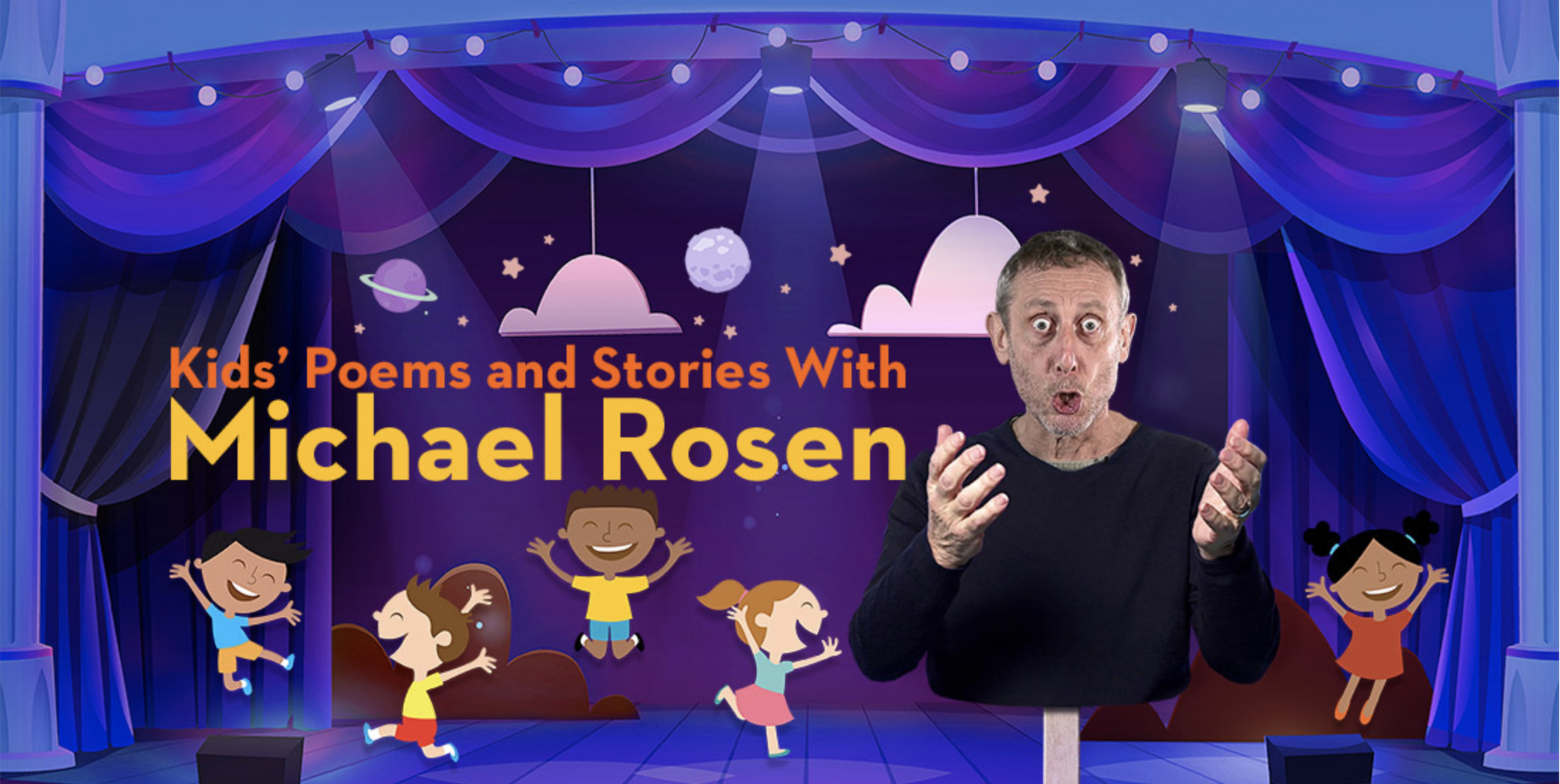
  1. 50 Years of Michael Rosen’s Children’s Poetry

This year is the 50th Anniversary of Michael Rosen’s first forays into writing for children. Can you imagine that? Rare is the child in England who hasn’t heard one of his poems – from ‘Don’t Eat Mustard with the Custard’ to his ‘A Great Big Cuddle’. Rarer still are those who cannot recite, with great fondness, a good portion of ‘Bear Hunt’. He has been doing lots of events and new publications this year – even more than his usual energetic output, with special events to mark his 50th anniversary. https://www.michaelrosen.co.uk/events/

2. Zig Zag Stanza

Poetry Society’s Stanzas – workshops for poetry writers – include one called ZigZag Stanza, co-ordinated by poet and editor, Rachel Piercey. It is a monthly gathering online where writers workshop their poems. Some are very well established and well-known, with several publications behind them and others are more new to this, like me. I attended my first one in March and found it a great source of constructive talk, sharing of ideas and experiences and most important of all, excellent workshopping suggestions on the poems that group members brought along. A personal revelation for me was the idea of being much more inventive and experimental with the look on the page. Having mainly read my poems out loud to my 5-year-old grandson, I hadn’t really been thinking enough about the visual impact on the page for children who are reading the poems themselves, especially if without accompanying illustrations.

https://poetrysociety.org.uk/stanzas/online/zig-zag-stanza-for-childrens-poetry

3. The CLIPPA Award

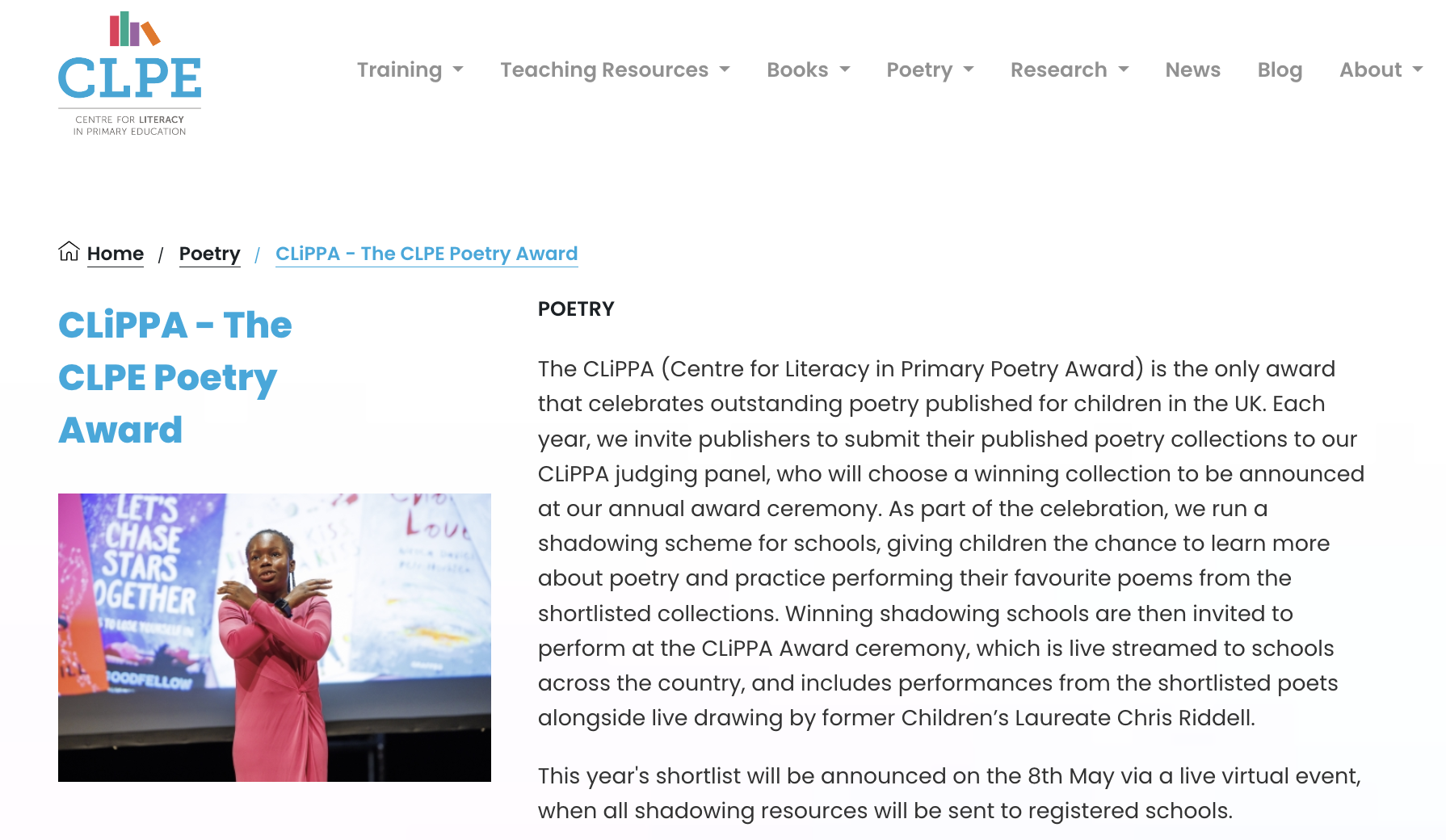
The CLIPPA Award for children’s poetry is run by CLPE (Centre for Literacy in Primary Education) and has given a terrific boost to children’s poetry publishing. The 2024 prize judging panel is chaired by poet Liz Berry. It has a Shadowing Scheme, where schools can read poems from the shortlist and send in videos of themselves performing their favourite poems. The shortlist will be announced on 8th May. https://clpe.org.uk/poetry/CLiPPA

4. The Children’s Poetry Summit

This is a UK network of individuals and organisations actively interested in poetry for children that shares ideas and good practice, and acts as a campaigning pressure group. It has a fabulous blog, with a regular stream of pieces by people of note in the children’s poetry world – Pie Corbett, Gaby Morgan, Brian Moses, Rachel Piercey and others. A recent piece by Cheryl Moskowitz was a great set of reflections on the rediscovery of the child in the poet and the way ‘the poet, like the child, achieves revelation by noticing, being open to possibility, making connections in the imagination, taking one thing for another.’

https://childrenspoetrysummit.com

5. The Dirigible Balloon

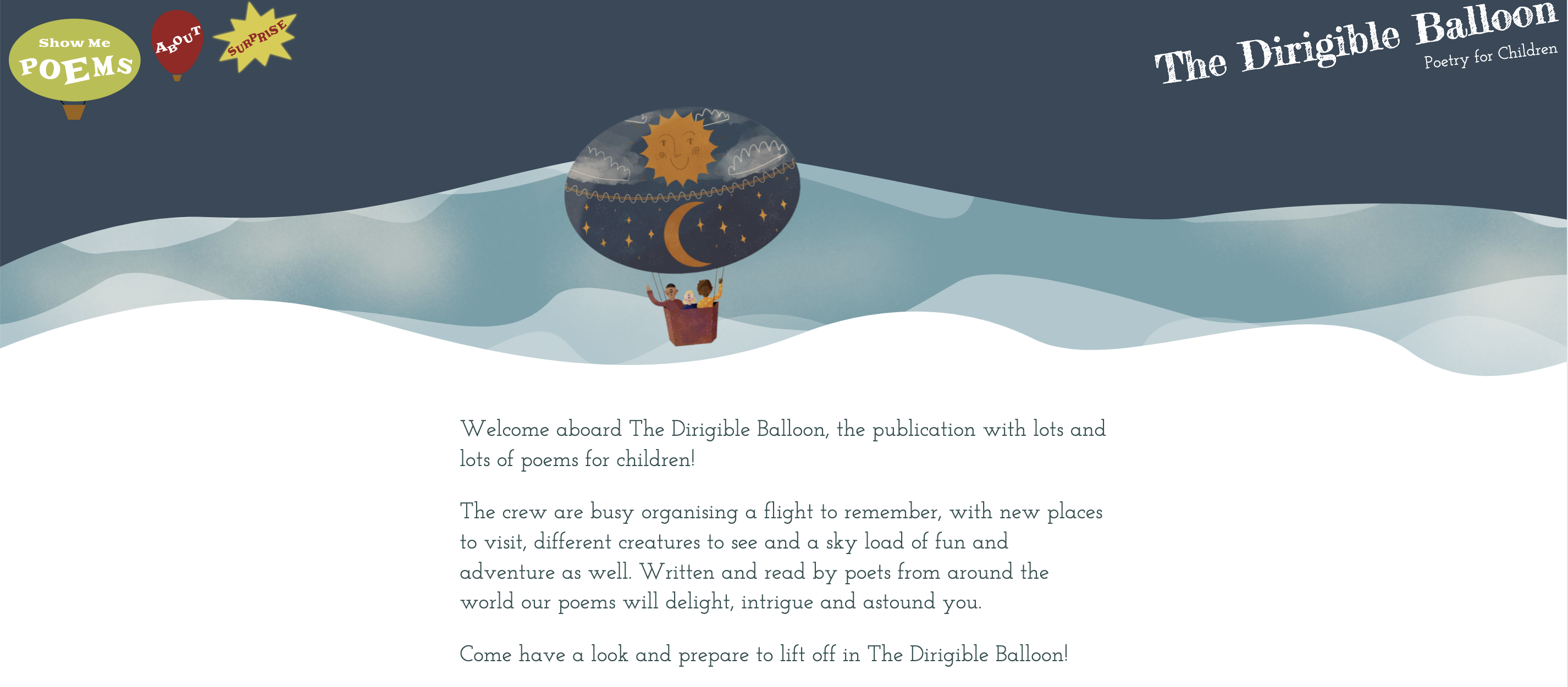
Finally, a special shout out to The Dirigible Balloon website, created and curated by the amazing poet and editor, Jonathan Humble. The site is lovely to look at, populated with poems of every kind, by well-known writers (Michael Rosen, Coral Rumble, Chrissie Gittens and A.F. Harrold among others) and newbies like myself. It’s a great resource for teachers (with a vast thematic as well as an author search) but it’s also an excellent showcase for poems, going beyond the narrow confines of magazine submissions, competitions and that most challenging of avenues – book publishing. Do look out for my own poems on the site, and for the anthology which has just been announced and will be published at the end of the year. I’m thrilled that one of my poems, ‘In the Garden’, will be included! https://dirigibleballoon.org/

Barbara Bleiman

April 2024

For more examples of my children’s poetry, go to http://www.barbarableiman.com

On Grandfathers

Story book grandpas are always very, very old. So old that their white beards are never shaved – maybe because they’re too old and weak to pick up a razor and shaving brush? Their backs are bent and, if there are pictures in the book, the facial features of one grandfather are indistinguishable from any other – just a tangled web of wrinkles, out of which peep (usually blue) eyes, in a perpetual state of either twinkling, or grumpy frowning. The twinkly grandpas offer kindness and comfort. The grumpy ones are a bit frightening but then somehow, in the course of the story, they always turn into the twinkly ones, usually as a result of the winning ways of their delightful grand-children. Johanna Spyri’s grandfather in Heidi is a classic example. He starts out as the cantankerous kind who ends up providing love and refuge for Heidi and is finally reconciled with the villagers with whom he has fallen out, and the church that he has long spurned. Grumpy to twinkly, in a nutshell.

The other kind of grandfather, of course, is the dead or dying one. Again, very old, again very wrinkled but this time with twinkly eyes that are about to shut forever. This storybook grandfather offers children a way of processing sadness and coming to terms with death and grief.

There’s something about these storybook grandfathers that once didn’t make me squirm, but now does. It’s obvious why, really, isn’t it? As I grow older, I recognise more acutely the ways in which old people’s individuality and personalities are flattened out and forgotten. Old is a new, and simpler, category of being; the grandfather is a ‘type’, rather than a person. But the truth is, he’s nothing like the grandfathers I have known, and the ones I know now.

My grandfather – Adolf

My grandfather and grandmother, on my mother’s side, lived in South Africa. They were unreachable, except by airmail letter, the very rare treat of an expensive operator-connected phone call, or a telegram in case of dire emergencies or momentous events. After saying farewell to them at Cape Town’s Jan Smuts (now O.R. Tambo) airport at the age of five, I only saw them both twice in total during my childhood – a visit ‘home’ and a trip by them to London for my brother’s bar mitzvah. But they were very important in my mother’s inner world, her sense of herself and her, sometimes fragile, belief that things would turn out OK in the end. She relied on them, even though they weren’t there to be relied upon. We got to know them via their letters, as well as through the news we received of them from the many visiting South Africans who passed through London on their ‘European tour’.

My grandfather was my mother’s favourite. She adored and respected him above anyone else in the world. So, it was a hard thing for me to discover, reading between the lines of letters and messages passed on by visitors, that my grandfather did not favour me. My grandfather’s favourite was my brother. Visitors were full of how much my grandfather thought of my brother. All the talk was about him and how proud my grandfather was of his achievements, his cleverness, his success at school. And on the two occasions we saw my grandparents, my grandfather made this clear too. I was excluded from playing games of chess – too young, too babyish, I’d spoil the game, my grandfather said. I was on the periphery of his sphere of interest, and never allowed into the warm circle of his full grandfatherly adoration. It hurt.

Now, with two grandchildren of my own, both equally adored, neither a favourite, unable to even conceive of how there could be limits or quotas on how much love is available to dole out, I think of my grandfather with regret and sadness. I missed out on him. But I think he also missed out on me. He died before I left school, went to university and entered the world of work. He knew nothing of the woman I was to become.

My grandfather – Oupa

My father’s father, Oupa, also living in South Africa, died when I was three years old, so I have no direct memories of him, just photographs of a neat, diminutive, dapper man, with a hat rakishly positioned on his head, standing a good foot smaller than my rather less stylish and attractive grandmother. By all accounts he was quite fond of me and my brother but perhaps it was lucky that I didn’t get the chance to know him more intimately as a presence in my life. I’ve written about him in my novel Off the Voortrekker Road. Though a fiction, many of the stories about Oupa are rooted in truth – the fact that he kept my grandmother desperately short of money for the household, that he was a harsh and unyielding father (tying my father’s left hand behind his back to force him to use his right hand and refusing to pay out for a bar mitzvah for him, to my father’s lifelong shame.)  His tightness with money extended to not being willing to fund my father’s university education. He could go out and get a job and earn some money, couldn’t he? Luckily my father was exceptionally bright and won one of only two or three scholarships in the whole of the Cape, allowing him to continue his education. My father grew up and succeeded despite his father, not because of him.

Oupa lacked basic decency in his family life – what Jews would call menshlichkeit. He was definitely no mensh! But this extended beyond the family too. His nefarious business exploits became the stuff of family legend. When times were tough, on two separate occasions, Oupa managed to successfully burn down his hardware stores, pocketing a large amount of insurance money, allowing him to set up afresh. In the process, he also burnt down my father’s treasured matchbox collection, a crime for which my father never forgave him.

Despite all this, Oupa may have also had a softer side and my mother tells a few stories of his kindness to her. Unlike my father, she was a practical young woman, quick to pick up new skills such as those needed in the hardware store –  cutting, chopping, sorting, fixing, weighing, measuring, dealing with customers. He clearly respected her for this. Perhaps Oupa’s antipathy towards my father stemmed from the fact that he just couldn’t understand a son whose intellectual achievements so far surpassed his own, while he had absolutely no interest whatsoever in the practical skills that Oupa so valued.

While it was probably no bad thing that I was protected from Oupa the man and all that went with his tempestuous relationship with my grandmother (Ouma), and my father, the stories I was told about him became a rich and important part of my childhood. Grandparents live on in memories, and this grandfather lived on in a particularly vivid – one might even say lurid – way. Grandfathers have value and significance, alive or dead. In my case, his larger-than-life character and exploits gave him a starring role in my first novel.

My father – the grandfather

My father was a loving parent, but not a hands-on one. Preoccupied with making (or sometimes failing to make) a living, and doing what was expected of him in those days, he didn’t change nappies, make dinner, do bath-time, put us to bed, read to us. On weekends, exhausted, and sometimes quite depressed, he took a ‘schluff’, a long sleep, in the afternoon, waking angrily when my brother and my arguments grew loud enough to rouse him. Practical care fell to my mother. When she was so sick she couldn’t leave her bed – just once in my memory – we discovered that he couldn’t crack an egg successfully. The kitchen floor was awash with slippery broken yoke and white and my father, a child himself, cried in shame and frustration and looked to us for assistance.

By the time my second child was born, my father had resolved his work problems, was much happier and on the verge of retirement. Suddenly Pappy Jack came into his own as a grandfather. He changed a nappy for the first time in his life, played with, and was adored by my son.

‘Why does he love me so much?’ my father asked, bashfully perplexed, yet basking in the pleasure of his grandson’s affection.

My mother came straight back, ‘Because you know who Mrs Goggins is.’

I saw my father become someone else. A grandfather. It was a route to the kind of connection that he’d missed out on with us.

My Grandpa Husband and Me

Googling grandfathers, I find a wonderful site called ‘Famous Grandfathers: A List of Bad Boys Who Are Now Grandfathers’, and they include hell-raisers Ozzie Osbourne and Alice Cooper, rock god Mick Jagger and actors Robert de Niro and Jack Nicholson. In among the stories are delightful photographs, including one of Osbourne pulling cross-eyed, goofy faces with his grand-daughter. How did this remarkable transformation happen?

My husband wasn’t a rock god nor was he a hell-raiser in his youth, and yet the transformation is, nonetheless, a big one. Yesterday – it was only a blink away, not a life time surely? – he was a long-blond-haired, hippyish student, in a leather airman’s jacket, desert boots and loons. He’d hitch-hiked across Europe, seen The Grateful Dead at the Bickershaw Festival, marched against racism and cuts and then gone on to a marriage with me, a demanding, serious job, and bringing up two children. And now here he is, ‘grandpa’.

The roles we played as parents, back in the 80s and 90s, wound up being quite stereotypical, much as we tried to break down the gender boundaries. I took a long maternity leave first time round and then gave up full-time work with our second child; my husband’s long hours and work responsibilities meant that, on weekdays at least, I took on more of the caring role, becoming the ‘expert’ in day-to-day minutiae, keeping track of who needed what, dealing with school traumas, preparing their food. But this time round, with a new batch of little ones, my husband has much more time to revel in minutiae. The one thing I’ve found hard to give up control of though, to be honest, is the role of food-giver. Whether it’s the ‘Jewish mamma’ syndrome, or something else, the pleasure of making food for the children – and now the grandchildren – is something I’ve struggled to be able to share and fought hard to retain. It seems that only I know whether a fishfinger, a sausage, or a plate of pasta is what is really needed and how to cook these culinary delights, despite my husband being an exceptional cook, generally acknowledged to be much better than me. The careful preparation of fishfingers and peas? That’s for me – not grandpa!

Grandpa (and Granny) are not really different from the complex, individual, complicated individuals we always were and always have been – quite good at some things and not others, cheerful sometimes but not always, full of our own quirks and preferences and interests. My husband hasn’t changed fundamentally,  the grandpa-ness being just a new, (very precious and important) add-on, a new layer of experience, enriching but not essentially changing who he is. This grandpa – the one who once went to the Bickershaw Rock Festival `– is not the grandfather ‘type’ but a unique individual.

So, let’s remember the real ones – my father who discovered the pleasures of being with a young child, my one grandfather who was only able to perform the role fully for one grandchild, not two, my other one who I only knew through the myth-making of family memories, my husband who hasn’t had a beard since his hippy days, who arrives for his babysitting duties on his motorbike, and has eyes that twinkle as much or as little as anyone else’s, young or old.

Barbara Bleiman

September 2023

On the Essay

So, here I am writing an essay. An essaie. A trying out of thoughts and ideas. I’m nervous. Is that obvious? Perhaps the blunt Hemingwayesque short sentences are a giveaway. It’s not my usual genre. An escape into fiction is easier. There, I can hide behind another voice, another life, a different kind of truth. There, it’s a truth that sidles up, unannounced, or leaves chasm-like gaps for the reader to leap over – or plunge into – and it comes from somewhere only half-understood or consciously planned.

Essays should be planned, shouldn’t they? That’s what you’re told at school. You make a list of points, you think through your arguments, you construct a logical sequence and decide where to place your strongest points, your knock-out quotation, your rhetorical flourishes. You follow your plan through. The problem is planning’s not my thing. I like to just get started and see where that takes me. I write to think, and think as I write. Open-endedness, an uncertain path, the lack of a map, the thrill of the unknown, the change of route along the way all seem to get me there in one way or another (eventually) and the journey has usually been an adventure. Writers differ hugely on this, I know, but for me the thoroughly planned writing route is a dull, wearisome plod.  My freshest thoughts appear on the trail, unexpectedly, as if from nowhere. The fog lifts, I reach the brow of a hill and a surprising new vista opens up.

And here’s another thing. If an essay is a trying out of ideas, what about feelings? Can feelings be ‘tried out’ too? An essay on feelings seems perfectly fine, but what about an essay of feelings, where feelings are the substance, where they do the heavy-lifting, rather than simply providing the content? Can my pulse race in an essay? Can I pause to look at that stunning pink and gold sunset, or, on a hike, feel the squelch on the soles of my boots, sucking me into the mud, or choke back the tears in a darkened room, as a father films his daughter on a camcorder at an airport, playing hide-and-seek with him for the last time?

These questions aren’t rhetorical ones – I’d like answers. And the route to these answers is in reading other people’s essays – not school essays but the kinds of essays that are published in book form.  If I ask, ‘can an essay do x or y or z?’ then going to essayists should help me find out. So here are a few observations about essays I’ve read in the past and more recently.

First, for me, some of the best essays are by brilliant thinkers, people who know a lot about something and think in exciting ways about that subject. Take Susan Sontag, for instance, writing about changes made by photographic images on our world and perceptions of that world in the collection On Photography in 1971.  It takes just five sentences in the first essay for her to come up with a stunningly insightful take:

In teaching us a new visual code, photographs alter and enlarge our notions of what is worth looking at and what we have a right to observe. They are a grammar, and even more importantly, an ethics of seeing.

Was this the first appearance of the idea of ‘reading’ visual images that have their own special ‘grammar’ – the metaphor of the written word being adopted for the visual in a highly illuminating way? Is it where the idea of ‘visual literacy’ originated. I’m not sure, but it’s a startling opening to a highly influential book. And the ‘ethics’ of seeing too. That’s an extraordinary phrase. It’s original thought encoded in surprising conjunctions of words that make one think afresh.

But not every great essayist is pithily constructing abstract new philosophies or highly intellectual ways of framing, or re-framing, the world. George Orwell is one of my favourite essayists and he generally follows one of two approaches. The essays are either a bit like a plainly stated, and carefully argued and exemplified, manifesto, or, in another style, more like a powerful story with a message – ‘Politics and the English Language’ is an example of the former, ‘Shooting an Elephant’, the latter. I like both. Both have a strong thesis, usually a political argument to be proved, and the engine of the essay never stutters or splutters but powers ahead full throttle.  This extract from ‘Shooting an Elephant shows Orwell being quite explicit about how the story he’s going to tell will throw light for the reader, as it the episode did for him, on some significant political idea, such as poverty, inequality, socialism or, in this case, imperialism:

One day something happened which in a roundabout way was enlightening. It was a tiny incident in itself, but it gave me a better glimpse than I had had before of the real nature of imperialism – the real motives for which despotic governments act. Early one morning the sub-inspector at a police station the other end of the town rang me up on the phone and said that an elephant was ravaging the bazaar. Would I please come and do something about it? I did not know what I could do, but I wanted to see what was happening and I got on to a pony and started out.

More recently, new genres of essay-writing seem to have sprung up, alongside the more conventional forms and perhaps these show how the essay can be something looser, more complex, with feelings and experiences allowable, and other things too. Annie Dillard’s collection The Abundance was gifted to me by Secret Santa, a collection of essays. That’s what the reviewer on the back cover calls it, and that’s how it’s billed. And yet it defies easy categorisation as such. There’s no thesis in the essays, no explicit argument, no explanatory voice, no concluding thoughts. Sections are not connected with each other, thoughts and feelings jostle with each other, sometimes randomly. There are stunning descriptions of landscape and wildlife and disturbing moments of alienation and confusion. Are they memoir? Writing from life? Are they, perhaps, even poetry? What exactly makes them essays? In the introduction to the collection Geoff Dyer talks of a recognised genre called ‘genre-resistant non-fiction’ and seemingly Dillard has been doing this since the 1970s, resisting convention and ‘essaying’ a different way of writing. Her focus is often, though not always, on the natural world, and herself in it, on trying to understand who we are and what our experiences in nature, and nature’s experiences of itself, might mean. So, in one essay she writes about an encounter with a weasel, about what it thinks and what she thinks and what that can tell her about both it and her.

Please do not tell me about ‘approach-avoidance conflicts.’ I tell you I’ve been in that weasel’s brain for sixty seconds, and he was in mine. Brains are private places, muttering through unique and secret tapes – but the weasel and I for a sweet and shocking time, both plugged into another tape altogether. Can I help it if it was a blank?

What goes on in his brain the rest of the time? What does a weasel think about? He won’t say. His journal is tracks in clay, a spray of feathers, mouse blood and bone: uncollected, unconnected, loose-leaf, and blown.

Dillard’s essays are metaphysical and philosophical and often quite strange, a bit off-the-wall. They leave you with powerful thoughts but few conclusions. If the essay has to have a conclusion, Dillard defiantly refuses to give you one.

To conclude, (or should I say thus, therefore, so, to sum up, or what you will) essays, these days, can be pretty much anything that is short, written in a writer’s own voice (I’ve come to this conclusion late on in my conclusion, for which apologies) and rooted in non-fiction. It can be poetic, it can tell a story, it can be brilliant philosophising (or not). It can follow strict rules or none. Perhaps it does have to have that element of ‘essaie’ of trying out something – trying out a thought, a position, a viewpoint, a way of understanding experiences. And the provisional, questing, enquiring nature of the name might help the reader to see it as something to enjoy for this very reason – that it allows us access to someone else’s mind, and their efforts to think things through, in a valiant literary attempt at something…whatever that may be.

Barbara Bleiman

April 2023

Hello reader…whoever you are!

I’ve been thinking about audience recently. If you’re reading this, who are you? A reader,  a writer, someone who’s come to this because you know me from my education work, a member of my family who reads whatever I write, either out of curiosity or familial reflected glory – what my Jewish mother would call shepping naches or kvelling.  You don’t have to buy a book to read this blog, or make a big time investment. It will take you just a few minutes if you get to the end. It may be that you just happened upon it and, if I’m doing a decent enough job, hopefully I will have drawn you in well enough for you to stay.

A blog is a relatively rule-free thing, which makes it both a pleasure to write and frighteningly open. It can be an erudite argument, a serious commentary, or as in this one, just an accumulation of thoughts on a topic. In this sense a blog is a luxurious, wanton, delightfully unruly form.  But the unknowability of the audience for a blog makes it hard to judge the tone and know whether you’re likely to be carrying anyone with you. With one decisive key stroke you might leave me.

If you’re still here, dear unknown reader, thank you very much. And now I’ll get back to why I’ve been thinking such a lot about audience. I’ve always written, from a very early age, but mainly just for myself, or for a teacher to mark or a parent to comment on. But then, after a long entirely audienceless period as a young adult, I started teaching, and found myself writing in small, experimental ways for other people – the occasional poem written specially for a class, a bit of doggerel for someone’s leaving do, a contribution to the Christmas panto.

It was when I had children that I suddenly found myself with a proper fully-fledged audience. I started telling stories and then writing ones that had the children in mind – Michaelmas Mouse stories for my toddler daughter and son, picture book ideas, and then later, when my son was at primary school, a book for him about a boy called Zachary, who is visited and befriended by a demanding, zany, perplexing but loveable grandpa-like figure who lands on his doorstep from outer space. I wrote a novel for my teenage daughter about a girl who is knocked down by a car and has to find new ways of living with a brain injury. I managed to get a children’s literary agent to take me on for these two books, but sadly, though I came close on a couple of occasions, I never managed to get a publisher for them – they didn’t think they’d attract a big enough audience.

When I started working for a teachers’ centre for English teachers, a few opportunities to write presented themselves. Running courses on classroom English, I always tried to weave in short writing experiments, exercises and activities that teachers could use with their students. Getting the teachers to try out the activities themselves was not only good fun for them, but also in my view gave them confidence and experience to apply in their teaching. I always joined in, and gradually accumulated a little collection of experiments in poetry and fiction – often sparked by another text – a parody mash-up of Pride and Prejudice and Cormac McCarthy’s The Road, a pastiche of William Carlos Williams’ ‘The Red Wheelbarrow’ all about an infuriating air-conditioning unit in a hotel, a memory in the style of a favourite writer (in my case Tim Winton’s opening of Cloudstreet).

These experiments had a fleeting audience, shared in sessions, laughed over and then put to one side. But I got a taste for some adult writing, shared with others in a workshop, and decided to do a Creative Writing MA. At Birkbeck, one night a week for two years, I began to take my adult fiction more seriously, and I’m sure that that was in no small part because there were people to share it with – a living audience for it.

The very first time I had to write a piece to share with my seminar group I had a sleepless night. Literally sleepless, which is quite unusual for me, someone who has had to face challenges at work, difficult classes and much more. I was terrified. But the terror was important. The fact of people reading my work was a catalyst for development. It forced me to up my game. I imagined the responses, stepping outside of myself to think about how someone else might react to that thing I’d just written.

Salman Rushdie said last year of a new writing project,

The infallible test of anything I write is embarrassment […] If I’m embarrassed to show it to you, then it’s not ready. There comes a point where I’m not embarrassed to show it and actually I’m kind of eager to show it.’

I love that idea of embarrassment as a driver for producing your best work! I will never be able to thank my fellow students enough, for their honest, open, serious engagement with my writing, whether it be to criticise, question, praise or, above all, to offer me opportunities not to embarrass myself.

I went on to write two adult novels and a collection of short stories, for which I have had a modest audience. Hooray! But now audience is right back in my head because, perhaps unsurprisingly, the arrival of two grandchildren has plunged me back into the waters of writing for children. I started telling a few stories and then writing some poems for my toddler grandson, Max. He has a wonderful device called a Tonie, where, by digital means, you can add stories and poems from afar. He can select Granny and Grandpa’s avatar, which sits on the top of the device, and by pressing it down onto the box, he can listen to whatever we’ve recorded for him.

As one might imagine, he is the perfect audience for my efforts. He responds – with honesty. I know which of my efforts are his favourites and which barely get a mention, and the requests for more are an impetus to write. Recently I sent a couple of poems I’d written for him off to a wonderful children’s poetry website, The Dirigible Balloon, and was thrilled to have them accepted. Hopefully my audience will now encompass more children.

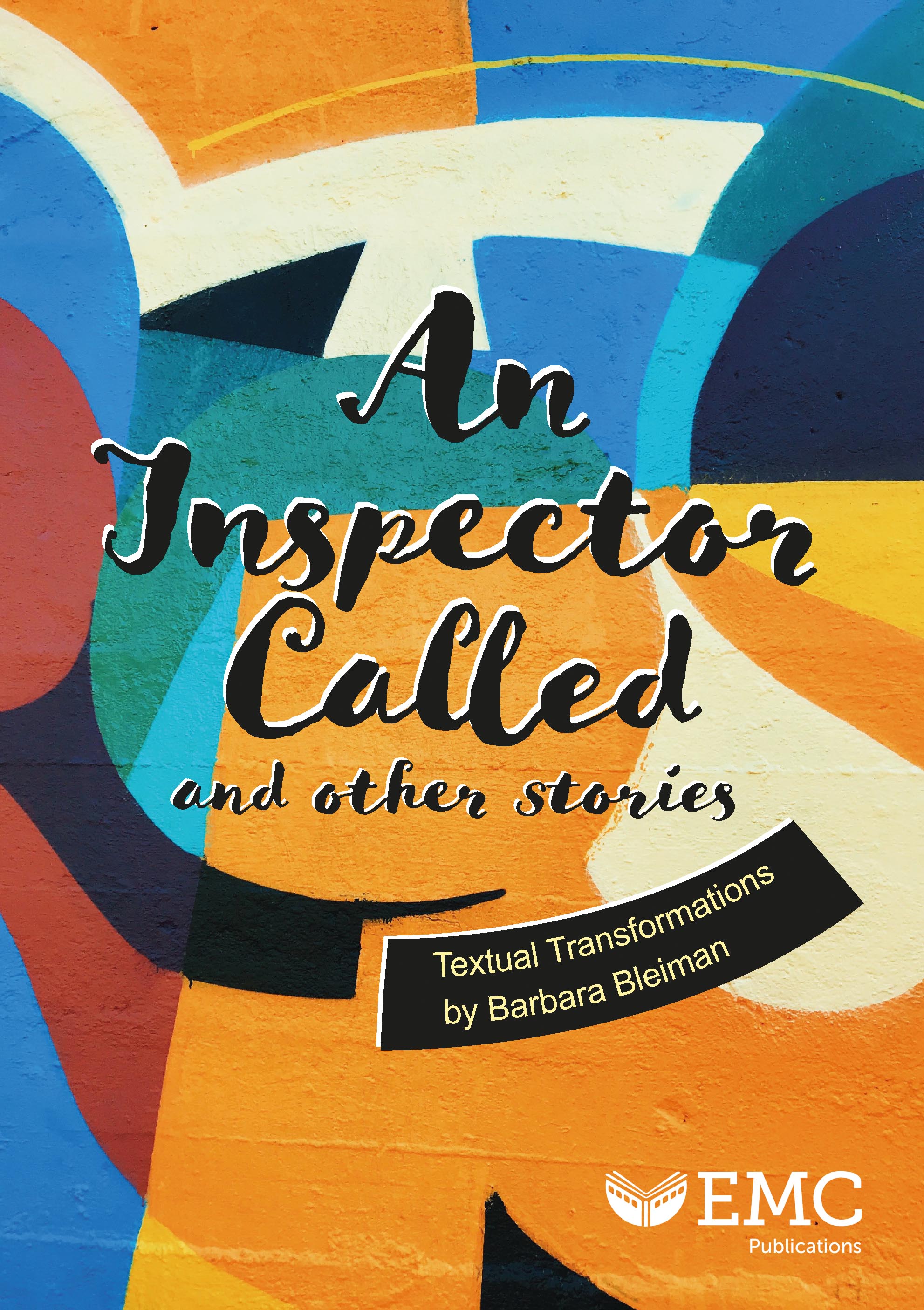
Just one last audience-related experience…I’ve written and had published a collection of short stories for young adults, An Inspector Called and Other Stories. (For more on this, see my blog) In the past, I might have bravely shared these with colleagues and, if they liked them, we might have gone straight to publication. But these days it doesn’t feel quite so simple. There’s a nervousness for writers and publishers about inadvertently causing offence, upsetting readers, saying something too edgy or writing in a way that is ambiguous enough to be misinterpreted. So, in this case, as well as sharing stories with colleagues, friends and family, as I always would, we put together a reading group of teachers to comment on the stories and the collection as a whole. Nerve-wracking, but thankfully the responses were very good and the book is now out. I’m especially excited that my audience this time will be young people in English classrooms.

My aim in the collection has been to offer interpretations and angles on texts that they are required to study, some of which they probably find quite heavy-going. My stories try to offer something that speaks more directly to them. Pretty soon, I’ll start finding out whether I’ve done a good job and whether I’ve judged my audience well.

So, for me, the audience for writing is essential. It is the spark, the catalyst, key to development, vital for stepping outside of oneself as a reader to understand how others might see things. It’s a reality check, a source of anxiety and sometimes, when something you’ve written is liked by others, of great joy. Truth be told, I don’t write just for myself – I want to be read.

If you’re still here, thank you for staying. If you stayed, do feel free to comment and even perhaps break the anonymity of the online audience and tell me who you are. Mum, that doesn’t mean you, though, of course, feel free to share your maternal pride (or embarrassment) in private!

Barbara Bleiman

To find out more about my writing and work, visit BarbaraBleiman.com

Details of An Inspector Called can be found here

How can I be the person I want to be? What literature teaches us about this crucial question

I have been reading about emotional intelligence (EQ) for the past twenty years, ever since I picked up Daniel Goleman’s book on the issue in the late 1990s. As a writer and teacher, I was drawn to the concept because it suggested that it’s not so much how much we know that defines our intelligence, but how we conduct our relationships. At the heart of the idea of emotional intelligence or emotional quotient (EQ) as it’s sometimes known, is the idea that we need to understand our feelings: how and why we respond to people and the world in the way we do.

In a certain sense, EQ suggests that there is a vital role for writers to play in helping us understand the world because it’s writers/storytellers/poets who explore the world of emotions. Until quite recently, scientists avoided the topic, and deliberately stripped their practice of ‘emotions’ – as many still do. Scientists are supposed to be ‘objective’ in their observations, and look at the world without ‘feeling’. Recently there’s been a backlash against this approach, with feminists most notably showing how scientific research has been riddled with unexplored patriarchal assumptions and biases, one of which is its mistaken belief that ‘feeling’ can be taken out of scientific experiments. A practice which has led to all sorts of unethical experiments and problems. The award-winning book, Invisible Women, by Caroline Criado Perez explores these issues, exposing the data bias in a world designed for men.

For the writer exploring emotions is at the heart of their practice. One way of looking at much storytelling is to consider the ways in which writers depict characters who struggle to be who they want to be, who grapple with trying to know who they really are. From Hamlet to Margaret Atwood’s Handmaids, it’s this internal struggle to truly understand oneself and achieve one’s desires which motors so many stories. The skill of the writer is to show the tragedy and comedy of this struggle in different contexts. It’s a struggle because constantly our literary protagonists are being put into conceptual boxes by other people. Hamlet is put into the box of having to avenge his father’s murder by his father’s ghost and many other ones by other characters; the Handmaids in Atwood’s two novels set in a fundamental Christian dystopia are constantly battling against the patriarchy suppressing their desires, their bodies, their thoughts. Atwood skilfully and scarily shows a world where no woman can be who she truly wants to be.

In the oeuvre of Blue Door Press, this issue comes up again and again. In Pamela Johnson’s Taking in Water, the main hero Lydia can never be who she wants to be because of the terrible secret she has had to keep about a horrific flood she experienced as a child. Jane Kirwan’s Don’t Mention Her explores how the death of a young child in a family affects the child’s mother, Connie. The tragedy unleashes a new side to Connie, a thirst to pursue what she wants in her life, to escape the confines of a dead marriage. Connie’s example and the tragedy have knock-on effects with other characters too, one of whom emigrates to Nigeria to be with the person she thinks she loves. Annabel’s Chown’s Hidden – A Memoir is a searing account of one young woman’s quest for meaning, love and good health, after a devastating cancer diagnosis. Again, the theme of finding the person you want to be comes up because the cancer eats away at Annabel’s hope, her sense of identity as well as her physical health. Barbara Bleiman’s Kreminology of Kisses is an eclectic series of short stories which all explore in differing ways the problems of desire in its manifold incarnations: the desire of a woman, who is having her portrait being painted, to escape the confines of the suffocating Renaissance world she lives in; the desire of the bureaucrat in Soviet Russia to find meaning in a stultifying surveillance state; the desires of lovers, children, parents to express themselves fully.

It should come as no surprise then that my own novels, The Last Day of Term, Who Do You Love, and Snow on the Danube all are peopled by characters who are seeking to be different people, yearning for escape, release, for reciprocal love and attempting to seek it.

If you are interested in this theme then, there’s no better place to start than with Blue Door Press’s work!

Off the Voortrekker Road by Barbara Bleiman

Barbara Bleiman’s novel, Off the Voortrekker Road, is set in South Africa in the 1930s and 1940s, a period that saw the rise of apartheid. This fiction draws heavily on stories told to her about her father’s early life in Cape Town, the child of Lithuanian and Russian Jewish refugees.  Her father became staunchly anti-racist and, as a barrister, defended many black and ‘coloured’ people (a term used then), who fell victim to a range of discriminatory laws.

The family moved to London when Bleiman herself was five years old. Though she was ‘altogether elsewhere’ in the UK, through her parents’ story-telling she felt steeped in that past and faraway world.

The two chapters that follow show the childhood of Little Jackie, the novel’s protagonist.  Chapter 2 sets the scene of his father’s hardware store where, through the eyes of a child, we see a society in which the fine gradations of race were an everyday reality.

Chapter 15 recounts a powerful experience for Little Jackie, a moment in his childhood that has a lasting impact on him.

Chapter 2

1939

Pa’s hardware store stood in Parow, at the far end of Main Road, the long thoroughfare stretching east to west across Cape Town that eventually came to be renamed Voortrekker Road, after the rugged, tough-minded Afrikaners who had settled the Cape. Parow, in those days, was quite a distance from the city centre, out beyond Woodstock, Maitland and Goodwood. Property was cheap and rentals easy to come by, so Malays and Jews, Afrikaners and English had started to crowd in, and the suburb was growing by the day.

On one side of the store was Irene’s, the women’s outfitters. It sold corsets and brassieres, blouses, suits and bright cotton frocks, the most glamorous of which appeared on two smiling, painted mannequins in the window. On the other side stood Krapotkin’s butcher’s shop, its large plate-glass window filled with pallid sausages, mounds of worm-like minced beef and lean joints of lamb hanging from silver hooks. A sticky yellow paper in the front of the shop was always black and buzzing with flies. Krapotkin was a large, pink-faced man, with hands as red and raw as the meat he handled and a voice loud enough to wake the cockerel himself. He was in the shop, from early morning till late at night, heaving dripping carcasses and slapping bloody joints of meat onto wooden boards, slicing, chopping, grinding, sawing through flesh and bone, all the while singing, laughing and swearing so loudly that my mother said that Krapotkin and his butcher’s shop would be the death of her.

The hardware store had a sign painted on the front with, “Neuberger’s Handyhouse”, in a clear, unfussy style. It stood a little apart from its neighbours, its whitewashed walls yellowed with age, its sloping tiled roof in some need of repair. On one side of the door stood rolls of carpet, stepladders and brooms. On the other were baskets filled with dishcloths and dusters, bars of waxy household soap and boxes of washing suds. A notice in the window said, “Everything you need, from soap and rice to chicken feed!” and “10% off for bulk bargain buys!” A faded red-and-white striped awning was pulled down every morning to provide shade from the hot midday sun and wound back up every evening when the store was closed.

My father, Sam, had bought the store six years earlier, just before his marriage to my mother and I was born a year later. He worked all hours, either out the front or in the back yard, cutting wood or linoleum, measuring string, counting nails and screws, cutting strips of biltong or weighing biscuits from the big jars that lined the counter. The hired girl, Ada, helped out while my mother moved between the kitchen, the back yard and the shop front, cleaning and cooking, talking to customers, and keeping an occasional eye on me.

 Where could I be found, on a typical day in 1939, four-and-a half years of age and living in the Handyhouse with my ma and pa? Occupying myself with toys? Splashing about in a tin tub of water to keep me cool in the blistering heat of the day? Playing a game of five stones with a little friend, or sharing a tasty slice of homemade melktert? No. I would be sitting in the corner of the store, on my sack of beans. The sack was high enough up for me not to attempt to climb down but not so high that I would do myself serious damage if I did. Little Jackie, aged four, knock-kneed, wide-eyed, dressed in shabby grey shorts and a grubby cotton shirt, stick legs swinging against the rough hessian of the bulging sack, sitting watching and saying nothing.

Ma would tell me stories at bedtime. Sometimes they were fairytales, sometimes family stories but often the two were mixed together, a blend of fact and fiction, magic and mundane, then and now; the biblical, the superstitious, the humorous and the sad, all woven together into a strange and complex fabric.

 ‘Once upon a time, long ago and far away, ’ my mother said, ‘there lived a man named Solomon, who was a cobbler. He was born into a Jewish family in a shtetl far away in Russia, a poor peasant, but clever and practical and full of hopes and dreams, a storyteller, a joker, the centre of attention at every wedding, barmitzvah, festival day or village party. He built a small wooden house for himself, he married a decent Jewish girl, he fought for the Czar, he saw his house burned and his synogogue razed to the ground, he felt hunger and he felt fear, and, finally he took his destiny into his hands and fled with his lovely wife across the wide seas, the swelling oceans to Cape Town, where he settled and had a family, a gaggle of girls, who, one by one married and left home themselves. One of his daughters was called Sarah. That’s me, Jackie, your own mother, your ma. Solomon is Oupa, your very own grandfather. ’ She kissed me on the head and then she carried on.

 ‘And then it came to pass that Sarah married Samuel. And they lived in a store and they called it the Handyhouse. And soon they had a child of their own, a little boy with many names: Jacob, Jack, Jankele, Little Jackie, son of Samuel and Sarah, grandson of Solomon, the shtetl cobbler, the man with a stout heart, a steel will and a voice that told an endless river of tales.

Your curly black hair comes from your grandfather, Jackie, your skin as dark as an Eastern prince’s, your black, black eyes, like the ‘ten a tickie’ buttons your father sells in the shop. Your looks you got from Oupa, that’s for sure. Maybe you got his cleverness too, with your serious eyes that always seem lost in your thoughts. But what happened to your voice, Jankele? Where oh where has it gone? Who knows? Perhaps it’s been locked up by an ogre, in a great big iron box in his castle? Maybe, like a little bird, it’s flown away over the seas to find its way home to its nest in Russia? It’s waiting there, collecting up all its stories, getting itself ready to fly back again to Parow, and tell them, when the right moment comes?

Four-and-a-half years old; too young to start school, too old to be carried around on Ma’s hip or wrap my legs round her waist and hang my arms from her neck, too big to sit in the highchair in the back room, sucking on rusks and pieces of salty biltong, while Ma, Pa and Ada bustled around me. So all day long, I sat on my sack of beans in the store, the Handyhouse, or in the sawdust on the floor, where someone could keep an eye on me. I watched the customers coming in and out, the bell tinkling as they stepped on the mat, carrying their parcels of dried peas or biscuits, candles or string.

 Here was Mr van der Merwe, with his flat nose and sunburnt face, his strong, hairy legs spread wide. He had patches of damp sweat under his armpits and down the back of his khaki shirt. He scratched himself inside his trousers, like Ma told me not to. ‘It’s rude in public,’ she said.

‘Ooh yirrah! That sun’s a bugger today.’ His Afrikaner voice was hard like gravelly stones and each word seems to trip up his tongue on its sounds.

‘I’ve brought you something,’ he said to Pa, dropping his voice down low, till it was almost a whisper. He handed over a small brown paper envelope. ‘It’s not the whole lot. But it’s the best we can do.’

Pa stared at him, stony-faced. ‘We’ve been waiting for well over two weeks now. Your wife promised to pay up days ago.’

‘Times are hard,’ said Mr van der Merwe, shaking his head. ‘It’s not easy.’

‘For us too,’ said Pa. ‘I’ll expect the rest next week.’

He turned abruptly to Millicent, the Shapiro family’s maid, to serve her. Mr van der Merwe cleared his throat, raised his hand awkwardly in a half-hearted farewell and left the shop.

With her yellow-brown skin, her hair plaited and knotted in tight rows on her head, Millicent was usually the last to be served, even when Mrs Shapiro had asked her to fetch back the family’s groceries in a hurry. I was dark-skinned, like Millicent, taking after my mother’s peasant father, as she had so often told me; not pale like Pa, or peachy-pink like some of the little English girls who came into the store, or red in the face like Mr Krapotkin, the butcher, not black-black like the boys who swept the road outside the store, or the labourers who climbed out of the truck every morning to work on the new shop across the road.

And here was Millicent, saying ‘Yessir’ to Pa and waiting to be served, as usual.

‘Tell your madam that I don’t have the crystallised fruit. I’m expecting an order.’

‘Yessir.’

‘And tell her the snoek is fresh from the smokery. Best quality fish. That’s why it’s a bit more pricy than usual.’

‘Yessir.’

‘And make sure you don’t throw away the bill by mistake when you unpack. It’s tucked inside the big paper bag.’

‘Yessir.’

‘At least you can rely on the Shapiro family to pay up,’ Pa said when Millicent had left and the shop had gone quiet. ‘A good Yiddishe family.’

‘Times are hard,’ Ma said. ‘With all this talk of Smuts taking us into the war, people are nervous – they don’t want to spend money.’

‘Times are hard, times are hard. That’s all I hear.’ Pa sighed. ‘Of course they’re nervous. Aren’t we all? But I’ve got a living to make,’ and he went out the back to the yard, slamming the door behind him.

Ada was cleaning the counter, slopping soapy water onto a cloth and wiping it vigorously, her thin arms stretching as far as she could reach, in great sweeping movements. She paused to wipe her forehead.

‘How’s your mother, Ada?’ Ma asked. ‘Any better?’

I felt sorry for Ada. My mother always said, ‘Poor whites are almost worse off than Cape coloureds. They have nothing.’ I liked Ada. She patted my head and kissed me on the cheek. She made me bread and butter when Ma was upstairs lying on her bed with her door shut. She told me silly jokes and sometimes, if the coast was clear and there was no risk of Pa appearing, she came up close and dropped a little chewy caramel into my hand. It was a shame if Ada had nothing.

‘My ma? She’s so-so,’ Ada said.

‘Would you like a little bit of time off to go and see her?’

‘Ag yes, missus. That’d be nice, lekker. But if you need me here, with it coming so soon and everything, then I’ll stay. My friend Maisie’s visiting Ma for me sometimes. I’m paying her a few tickies to go by the hospital and check on her. But it’s not the same as me going myself. It’s not long now, the doctors say. Her time’s coming.’

‘You’re a good girl, Ada, and you don’t usually ask for these things. And you’re a hard worker as well. Even Sam thinks so. I’ll talk to him and maybe you can go early this evening and come back on Thursday. Give you time to see your Ma.’

‘Thank you missus. You’re good to me.’

Ma went over and patted her on the shoulder. ‘And now I think I’ll go find Sam and speak to him.‘

Ada came and picked me up from the floor. She brushed the sawdust from my shorts and kissed me heartily on the cheek.

‘You don’t know what’s coming little man!’ she said. ‘You don’t know what’s gonna hit you, when your ma’s time comes.’ She laughed heartily, but I didn’t know what was so funny. Ada’s mother’s time was coming; Ma’s time was coming. Ma’s time kept coming and coming but it never seemed to arrive. And when it did, I couldn’t think what it was going to bring.

Chapter 15

1944

One day, a good few months after our return from Bloubergstrand, Mrs Mostert came into the shop with Terence. He was smiling at me and tugging at his mother’s arm.

‘Ask,’ he said. ‘Please mama, ask.’

He flapped his arms up and down wildly. Mrs Mostert laughed. ‘You look like you’ve just eaten a hot babotie Terence! Calm yourself down.’

She turned to Ma. ‘Would Jackie like to come for a day out at the beach, at Hout Bay?’ she said. ‘It’ll be a long day, but he can sleep over at the garage so we don’t disturb you coming back late. It’ll be a chance for you to have a bit of a rest. It’d do you good, I’m sure – you must be in need of a break, with the baby on the way.’ She paused. Sauly was looking up at her with big open eyes. ‘ And Saul can come too if you like.’

Ma placed one hand on her growing belly. She smiled.

‘Both boys off my hands for a day… and no Sauly waking me up first thing in the morning. Boy, that’d be something!’

But then she saw my crestfallen face. Sauly was a nuisance; he cried and whined and wanted to join in all my games. If I refused, he went running to Ma to complain. If I let him play, he invariably spoiled things by ignoring the rules. It always ended up in arguments and tears and Pa or Ma would step in, crossly reminding me of my duties as an older brother and the expectation of greater maturity that rested on my shoulders. In one way or another, Sauly always managed to make trouble. And what’s more, he was clearly becoming Pa’s favourite, usurping the position that I had once held and now lost, seemingly forever. Sauly was quick with his fingers, keen to help when Pa constructed paper aeroplanes or little balsa wood boats. He loved weighing and measuring, playing with all the little implements that Pa had made for me when I was small and in which I had failed to show any real interest. Sauly was not my favourite person.

Ma looked at me hard, then sighed. ‘ Let Jackie go on his own. It’ll be a nice outing for him. He deserves something good for a change.’

Terence and I shared a conspiratorial smile.

Ma packed up a small little bag with a towel and my grey woollen swimming trunks, a pair of pyjamas and a toothbrush, Sauly all the while howling in the background, ‘ Me toooooo, me toooooooo.’ I suddenly felt sorry for him and a bit ashamed at the delight I felt at leaving him behind. Should I tell Ma that I wouldn’t mind if he came along? No. It was too good an opportunity to be free of him and the rest of my family as well. I didn’t say anything.

Ma moved heavily over to the jars of biscuits on the counter. She unscrewed the lids and filled a big paper bag with a good mix of the best biscuits. ‘For the journey,’ she said. My eyes were focused on the door, watching in case Pa came back in at any moment and caught her at it and said something embarrassing in front of Terence and Mrs Mostert, or worse still, found some reason why I could not go to Hout Bay after all. But Ma managed to hurriedly scoop up some extra fig rolls and drop them quickly into the paper bag and collect everything together for my trip to the seaside before Pa had returned from his errands.

Mrs Mostert gave Ma a quick squeeze on the arm.

‘I’ll bring him back safe and sound, tomorrow evening,’ she said, ‘I promise you.’

*****

Walter is driving the Chevy. Mrs Mostert is sitting beside him. Walter is singing at the top of his voice, a jazzy tune that makes him sound like he’s laughing as he sings.

Pack up all my cares and woe

Here I go, singin’ low

Bye, bye, blackbird.

Where somebody waits for me

Sugar’s sweet, so is she

Bye, bye, blackbird.

From time to time, Mrs Mostert and Terence join in. I sing along, but only in my head, not out loud and the words I sing are a little different. Bye-bye, Cape Town. Bye-bye, the store. Bye-bye, Ada. Bye-bye Ma, Bye-bye Sauly. Bye-bye Pa.

On the back seat, we sit surrounded by bags, beach balls and striped towels. I look out the window as the houses of Parow and Cape Town flash by. Table Mountain looms up, a thin layer of cloud hanging low above it, like white marshmallow, and beneath it the gardens of Kirstenbosch lush and green, with the rhododendrons in full bloom. Soon the buildings and houses thin out and are replaced by countryside: fig and loquat trees; orange groves, grassland, rocky boulders; shacks with corrugated iron rooves and dusty yards with petrol cans, old tyres, goats and donkeys; clumps of thin pine trees; an open, empty road; a black man and woman, carrying cases on their heads, walking slowly from somewhere to somewhere, with the morning sun beating down on them; a single candyfloss cloud; the dust of an open-back lorry filled with African labourers, who smile and wave as they go by; a man sitting under a fig tree with a small pile of over-ripe mangoes for sale; a large bird swooping down to catch a lizard in its beak; the wild squawk of seagulls. And then at last – at last! Flashes of bleached white sand and foamy turquoise sea.

Walter parks the car and we carry everything out over the hot sand which burns my bare feet and makes me hop and skitter down towards the cooler wet sand near the sea. He sets up the big green umbrella, the towels, the picnic blanket and the hamper in a quiet spot, not too close to other bathers. There are coloured families sitting on the sand, making sandcastles and swimming in the sea, and there are white families, sitting in a different part, making sand castles, and swimming in the sea. We sit on our own, neither with the coloureds nor with the whites, in a strip of no-man’s-land dividing the two. Mrs Mostert splashes sun oil on Terence’s nose and shoulders but not on mine. ‘You don’t need it, Jackie, with your nice olive brown skin, like a little Arabian prince.’

 Terence and I fight our way out of our clothes, flinging them down any old where, forcing our legs into tight woollen swimming trunks, poking them in the wrong way, getting our toes stuck in our hurry to get down to the sea. We race out for our first swim of the day, plunging into the shallow waters and splashing wildly, as the waves crash in and suck noisily back out again.

At midday Walter takes our lunch out of the hamper, which has been packed with ice to keep the food cold, and puts the dripping containers down on the large picnic blanket. He lays the sandwiches out on the plates and, with a sharp knife, slices up a large watermelon. It splashes pink juice and pips onto the white linen cloth that the sandwiches have been wrapped in. He opens cold bottles of fizzy drink, which hiss as he pulls off the lids with his teeth. My drink tips up in the sand and it bubbles and trickles away before anyone can right it. The tears are coming but Walter only laughs and reaches into the hamper for another. Terence giggles. I smile shyly and take a big gulp of soda that explodes in my mouth, like the froth of a sugary sea.

Walter sits down on the big picnic blanket and opens a bottle of beer for himself. I watch him. He helps himself to sandwiches. He is in his swimming trunks, legs stretched out, toes in the sand. He is sturdy, though not especially tall. His arms are strong and muscular, his skin hairless and brown. The hair on his head is short. It is springy and black, with just a fleck of grey here and there. His mouth seems to take up most of his face, his teeth a little crooked but white against his dark skin.

I look at Mrs Mostert. She too is watching Walter, with a little thoughtful little smile on her face. She is plump and pale, soft and large as a cream bun, rolls of fat appearing at the top of her bright-blue swimming costume. Her hair is unpinned from its usual knot, and tangled from the salt and the wind. Without her usual dusting of face powder, her nose and cheeks are spattered with freckles. She’s not the same Mrs Mostert who collects me from the Handyhouse in her tidy skirts and dresses, or the business-like woman who serves customers at the garage. Everything about her has loosened, expanded, softened.

After lunch, Terence and I build sand castles and dig ditches, then run back into the sea, splashing in the shallows, while Walter and Mrs Mostert lie back on their towels and doze, close to each other, sheltered by the big green umbrella. The warm seawater rises up and washes over me. I wonder what Sauly is up to at home and am glad that he hasn’t come too. No Sauly, no Handyhouse, no Pa.

Terence finds a large piece of driftwood, gnarled and knotted and bleached white by the salt of the sea. He wants to show it to Walter, to ask if Walter can carve something out of it with his knife. We run back along the beach, scanning the umbrellas for the big green one that signals our place on the sand.

As we get close to the umbrella, I see that Walter and Mrs Mostert are not alone. They are both sitting up straight and two men, fully dressed in short-sleeved shirts and cotton trousers, are standing in front of them.

‘Stay in the sea,’ shouts Mrs Mostert but we are already out of the water and running up the beach to see what is going on.

‘Stay away boys,’ calls Walter and then, more sternly, ‘Don’t come closer.’

Terence and I hold back. We stand where we are, watching, unable to go either backwards or forwards. Now Walter gets up from his towel and places himself in front of Mrs Mostert, standing between her and the men. There is shouting. There are bad words.

‘Pasop. Watch out you blerry kaffir-lover,’ one man is yelling at Mrs Mostert. ‘We’re gonna donner you and that coloured bastard of yours.’ This man is tall and thin, with an angular face and a long jaw. His face is red with fury.

The other man, smaller and fatter, with large sweat stains on his shirt, is yelling too. He’s holding a big stick that he is swinging towards Walter, only narrowly missing him each time, like he’s playing a game with him. Walter looks about to see if anyone will come and help them. On towels, stretched out, or under their umbrellas, people are reading their books or sunning themselves. Children are playing ball or digging in the sand. Everyone sitting close by has turned away, facing the sea, or looking towards the ice-cream kiosk and the café in the distance. No one acknowledges that anything is wrong.

Terence is trailing the large piece of driftwood behind him. I wonder if I should grab it and run and hit the men with it. I could bash them on the legs, whack them as hard as I can, hit them and hit them till they run away. But I don’t move. I just stand on the sand watching. The tears are coming and I can’t hold them back.

The man with the stick prods Walter, stabs at his feet, as if poking at a crab to make it close up tight inside its shell or scuttle away in fright. Walter stands his ground but makes no move to stop him. I don’t understand why. Why doesn’t he just grab the watermelon knife from where it’s lying on the cloth and use it to defend himself. The man grips the stick more firmly. He grunts as he takes a bigger, faster swing which arcs towards Walter, whipping his legs so that he flinches. And now the other one, the thin one who up until now has just stood and shouted, joins in, punching Walter in the face so that he falls back heavily onto the picnic blanket. He falls into the plates and left over sandwiches and overturns the hamper. Mrs Mostert screams. At the sound of her voice, the two men casually turn away and stroll off down the beach, as if enjoying the nice weather and a relaxing day at the seaside. One whistles as he walks. The other laughs.

Mrs Mostert is weeping and now faces from nearby are turned towards us, watching. But no one moves from their places under their umbrellas. They just sit and stare.

‘Don’t worry, May. It’s OK. I’m all right,’ says Walter, dabbing at his mouth, testing the damage. He spits out a single, bloody shard of broken tooth and holds it out on his hand. Mrs Mostert passes him the white linen cloth that the sandwiches have been wrapped in and he presses it to his face to stop the bleeding.

He looks anxiously towards Terence and me, to see if we’re OK.

‘Let’s pack up, boys. It’s time to go home.’

Slowly we collect everything together and put down the umbrella. Walter carries most of the bags but we help with the buckets and spades and beach ball, which we hand to Walter to put in the boot of the Chevrolet. He takes out the little plastic plug and squeezes the ball, allowing the air to slowly exhale, till the ball is a flat, flabby circle, hardly recognisable any more.

In the car, Mrs Mostert is sniffing into her handkerchief. Walter pats her knee gently.

‘We’re OK,’ he says. ‘No real harm done. We’ll be fine when we get back to Parow.’

Terence, who has been sitting quietly next to me, asks, ‘Who were those two men?’ and his mother says, ‘Just nasty men, silly men. Don’t worry, we won’t see them ever again.’

 ‘Your face is all puffed up,’ Mrs Mostert says to Walter. ‘Does it hurt a lot?’

‘It’s OK,’ Walter replies. ‘A pity all the ice melted. It would have been good as a little icepack to keep the swelling down.’

‘You want to go back home Jackie, instead of coming to stay the night with us?’ asks Mrs Mostert kindly, twisting in her seat to look at me. ‘You upset by what’s happened and want to be with your Ma?’

I shake my head. ‘I want to stay the night with Terence and you,’ I say.

‘Good boy,’ says Mrs Mostert. She turns back to face forwards again. There is a little pause. Her voice is light, breezy but I sense something important is being said. ‘Perhaps don’t tell your Ma and Pa about what happened, then, eh? No need to worry them with nonsense like that. Better for them not to know. We’re all fine aren’t we? All done with now. I’ll make a nice chicken pie for supper when we get back and it’ll all be forgotten.’

I nod my head. All will be forgotten. All will be forgotten. Nothing will be said.

*****

When I got back to the store the next morning, Ma asked me how the trip went.

‘Was it fun?’

I nodded.

‘Did you swim a lot?’

I nodded.

‘Did you eat a nice picnic?’

‘Yes.’

‘Did Mrs Mostert drive you there?’

‘No.’

‘Oh,’ said Ma, surprised. ‘So who drove you all that way out to Hout Bay? Not Mr. Mostert, I suppose. He’s still sick in the sanatorium with tuberculosis from what I’ve heard. Been there for months now.’

‘Walter.’

‘Walter?’ said Ma. Her face flushed red. ‘I didn’t know Walter was going with you to Hout Bay.’ There was a moment of hesitation and then, ‘Does Walter often go on trips like this with May Mostert?’

I shrugged.

‘Is he around with you a lot, when you go to visit Terence at the garage?’

I said nothing.

‘Does he sit and eat with you at the table, for instance.’

I nodded. Was that the right thing to do?

‘And come and go in the house as he pleases?’

I looked at her and said nothing. Why did this matter? Why was Ma asking all these questions?

‘How friendly is he with her? With Terence?’

I shrugged.

‘What on earth is going on between May Mostert and Walter?’ Ma said under her breath.

‘Ma, is Walter Mrs Mostert’s other husband?’ I asked. It was a question I had often wanted to ask and it didn’t seem to me to be a dangerous one. I didn’t think Ma would mind and since I couldn’t ask May or Walter or Terence, Ma seemed like my best bet. She would know.

Ma frowned. ‘What sort of question is that?’

I went on, undeterred. ‘Is Walter Terence’s pa?’

‘Of course not, silly boy. What put that into your head? Walter’s coloured. He’s the paid boy at the garage. How could he be Terence’s father? Terence is white and Walter’s a kaffir. And anyway it’s none of your business. That’s something for you to think about when you’re a big boy, not now.’

There was a little pause.

‘Was everything nice at the beach Jackie? No problems or anything?’

I nodded vigorously in response to her first question and shook my head firmly to her second.

Mrs Mostert had told me not to say a word. I had followed her instructions. Whatever trouble she wanted me to deny, whatever revelations she was concerned to prevent, I felt sure that I had succeeded in doing as she said. I’d not given anything away. As far as I was concerned, Ma was none the wiser and I had done my job of staying silent. Ma’s frowns and questions didn’t worry me too much. May Mostert had asked me to keep a secret and I was pleased that I had managed to achieve that.

Barbara Bleiman is an education consultant and writer at the English and Media Centre (EMC). Off the Voortrekker Road is her first novel, published in 2015. It was followed by Accidents of Love in 2017 and a collection of short stories, Kremlinology of Kisses, which was published by Blue Door Press in October 2012. She has also written a book about English in secondary education, What Matters in English Teaching, (April 2021). She blogs and writes for EMC and on her own website http://www.barbarableiman.com.

You can find a PDF of these extracts here:
‘5, 4, 3, 2, 1. We have lift-off!’ – a Zoom Launch

On 7th December Blue Door Press held a launch for my new collection of short stories Kremlinology of Kisses. I was thrilled with the number of people who came along, over 100 households signing up for it. Zoom launches, in these times of Covid, may seem like a second-best option and it’s true that not being able to chat to people before and afterwards, share a drink and allow everyone to see and hold a physical copy of the book (and have it signed) is a major drawback, and was rather a disappointment.

But there were some other, quite significant, compensations. Friends and family were able to come from far and wide, including Scotland, Norfolk, France, Germany and the USA. The audience was much bigger than it could ever have been in a hired venue and there were no worries about how much wine to buy, transporting wilting canapés and no fears about either ending up with a big empty, echoey space or a horrible, sweaty crush.

Another benefit is that Zoom allows you to record an event automatically, and given that my wonderful work colleague, Lucy, had ensured that the whole thing worked like clockwork, with all the transitions between me and others being quick and faultless, the recording ended up being a great record of the event. I’ve now put it up on my website, so it’s available to those who wanted to come but were busy that evening…and it’s now available, of course, for others to watch too.

For anyone interested, it includes a reading of one of my favourite stories in the collection ‘The Sitting’, an interview between me and award-winning writer Lawrence Scott and an audience Q&A. The interview was a lovely opportunity for Lawrence and I to discuss the collection, my writing process, my views on short fiction in general and others aspects of my literary life.

Here’s the link if you’d like to see it:

https://www.barbarableiman.com/events

The book is available here:

Barbara Bleiman

Kremlinology of Kisses

What’s in a kiss? Desired, unwelcomed, missed?

In these twelve short stories, Barbara Bleiman explores the significance of a kiss in the lives of multiple characters. From Renaissance Italy to a prostitute’s bedroom in contemporary London, from the USSR under Brezhnev to a 1970s package holiday in Spain, from a hospital ward today to a ‘bubble’ far in the future, the stories adopt different voices and genres, creating a kaleidoscope of contrasting angles and styles.

Inspired by Chekhov’s iconic short story, ‘The Kiss’, this richly varied collection –  wistful, sensual, painful and at times quirky and comical–  appeals both to the head and the heart.

Bleiman’s precise, economical prose vividly evokes a remarkable variety of characters, situations, emotions, times and places.

Nicholas Tredell

I thoroughly enjoyed being immersed in these rich slices of life.

Kate Clanchy

Kremlinology of Kisses is published on Amazon, as a print-on-demand paperback book or an ebook. It is available here

Kremlinology of Kisses: a reflection and its launch

I’ve always loved short fiction. When I went to my interview at Birkbeck for a Creative Writing MA, over a decade ago, I had in my bag Flannery O’Connor’s collection A Good Man is Hard to Find. It was my talisman. I’d always loved the way O’Connor married emotional truthfulness and precise detail about a specific region, the deep south of America, with something more strange, mysterious and full of wonder. I entered the world she created and, on the final page of each story, I remained there long after closing the book. There was always more than met the eye, a conundrum or a human puzzle, a question left unanswered, a marvelling at the oddness (yet unsurprisingness) of human life and behaviour. As O’Connor herself said in her writing about fiction, a story is not a story if it can be summed up, if its ‘theme’ can be announced plainly, as if it were an argument. For her, fiction is all about ‘mystery and manners’. Fiction cannot be fully explained.

At that Birkbeck interview, I was asked why I had applied and what I wanted to learn. The answer was quite simple; I wanted to know how to tell, withhold and reveal, and how much, in other words how to get that fine balance that writers like O’Connor and Alice Munro and William Trevor achieve, seemingly so effortlessly, between the reader knowing too little and knowing too much. 

In my MA dissertation I decided to submit a collection of short stories, inspired by reading Chekhov’s famous short story ‘The Kiss’. I started to explore the significance of the kiss in many different contexts – something rather taken for granted perhaps in everything other than romantic fiction. The chance to workshop the stories helped me enormously in having a live audience who could respond to drafts. My co-students gave me invaluable feedback on many aspects of my writing, including that most important issue for me, of what to withhold and what to reveal. Some of the stories in my new collection, Kremlinology of Kisses, and the whole concept for the collection, emerged from that work. I then added to these, bit by bit, over time

The stories in Kremlinology of Kisses are all very different. They’re written in multiple styles and voices, in different genres. They span different times and places. They certainly don’t have the stability of setting of Flannery O’Connor’s regional work, or of William Trevor’s Anglo-Irish stories. And yet there’s a common thread to them and a set of ideas about people and their lives that allow the stories speak to each other, as well as to the reader. They explore ideas about intimacy, or the lack of it, about opportunities grasped or missed, about the importance of a kiss and what it might signify. I hope they will provoke questions as much as offering answers and that, like the bowls of porridge, the chairs and the beds in the famous fairy tale, I give away not too little, not too much, but rather what’s just right!   

Kremlinology of Kisses is published on Amazon, as a print-on-demand paperback book or an ebook. It is available here

Blue Door Press is pleased to announce the online launch event on December 7th at 8pm, where Barbara will read from the collection and be interviewed by writer, Lawrence Scott. There will also be a Q&A session.

Please book here if you wish to join us.

https://www.barbarableiman.com/events